After our son was born, I wanted a paternity test.
I’m not going to tell this in a way that makes me look good, because I don’t deserve it and because it isn’t true. Nico came out with his mother’s dark eyes and a scowl that made the nurses laugh, and I was there, and I wept, and I cut the cord with shaking hands. For three days I was the happiest man in the state. And then the doubt started — and I want to be precise about where it came from, because doubt never knocks and introduces itself. It comes in wearing someone else’s coat.
My mother had never liked my wife. Lena was too quick for her, too unwilling to perform daughter-in-law. And in those first weeks, my mother’s voice was a tap I couldn’t shut off: he doesn’t have our ears, does he? Babies in our family don’t look like that. I’m just saying, Matt, you’d want to know, wouldn’t you?
So I asked my wife — my wife of four years, who had never given me a single day of cause — for a paternity test. The words landed in our kitchen like a dropped plate.
Lena didn’t cry. She looked at me for a long moment, and then she smirked — I understand now it was the face hurt makes when it refuses to give you the satisfaction of tears — and asked:
“And what if he’s not?”
“Divorce,” I said. “I won’t raise another man’s kid.”
She held my eyes and said the sentence I’ve heard every night for three years: “Do the hospital test then. The real one. Promise me, Matt — not some kit from a box.”
I didn’t promise. My mother had already ordered the kit.
You know the rest, or you think you do. Two cheeks swabbed, one envelope, ten days, and then a printout with a number on it: 0.00% probability of paternity. I didn’t hold my son again after that morning — a choice he’ll spend his life not knowing about, and I’ll spend mine trying to make up for. I divorced Lena. I signed away parental rights in an office with fake plants while she sat across from me with the baby on her hip, silent, emptied out, done begging a man who had chosen a piece of paper over everything she’d ever told him. I disowned the kid. I moved four hours away. I told people the marriage ended over “trust issues,” which was the only true thing I said in that whole year.
Three years later, a letter came from a law firm I’d never heard of, thick as a seed catalog, referencing a class action settlement I nearly threw away as junk. A contaminated batch. A mail-in DNA kit company. Tens of thousands of results compromised between certain dates — false exclusions, the letter said, which is lawyers’ Latin for we told thousands of men their children weren’t theirs, and we were wrong. The dates matched. The kit matched. The lot number matched the box my mother had ordered while my wife begged me to use a hospital.
I did the hospital test this time. Through a court channel, with Lena’s wary permission and a social worker cc’d on everything. And when the envelope came I stood at my kitchen counter for a full hour before I could open it.
99.98% probability of paternity.
To my horror, three years too late, I found out the truth: my son is mine. He has been mine every day of his life — through the divorce, the signatures, the cold terrible years — and the only thing in his life that wasn’t mine was the mistake I made leaving it.
I sat down on the floor of my kitchen and threw up twice, and then, for the first time since I’d watched a printout unmake my family, I understood Lena’s smirk. It hadn’t been guilt. It had been the last face of a woman watching her husband pick a door she couldn’t stop him from walking through.
There is no version of this where I show up at Lena’s door and make a speech and something montages. She opened the door with Nico’s drawings taped at knee height behind her, looked at the envelope in my hand, and said — before I’d said a word — the truest thing either of us managed that day:
“I told you he was yours. I told you on the floor of our kitchen with an eight-week-old in my arms, and I begged you for the test that takes an hour at a clinic, and you chose a box your mother bought over me. Whatever is in that envelope, Matt — I knew it before you did. I never needed it. He never needed it. You did.”
I didn’t defend myself. I’d rehearsed apologies in the car for four hours and every one of them had the same shape — a demand that she feel better so I could feel less. So instead I gave her the three things I’d brought, and they were paper, because paper was all I had the right to offer: a cashier’s check for three years of child support I’d never been asked for and had thirteen different legal excuses never to pay; paperwork for an education trust in Nico’s name, irrevocable, no conditions; and a short letter saying only this — I will not ask you for anything. If you ever decide he should know me, I will come however slow, at whatever distance, under whatever rules you set. If you never decide it, the money is his regardless. He is owed a father. I am not owed a son.
Then I got in my car and drove home, and I want the record to show that the hardest part of that whole day was leaving with the door still closed.
Five weeks later she called. Not to forgive me — to say that Nico had found a wedding photo, pointed at me, and asked who the smiling man was, and Lena, who had never once lied to her son, had told him the truth in the shape a three-year-old can hold: That’s Matt. He’s your father. He made a big mistake, and grown-ups have to be very careful when they make big mistakes, so we’re going to be careful.
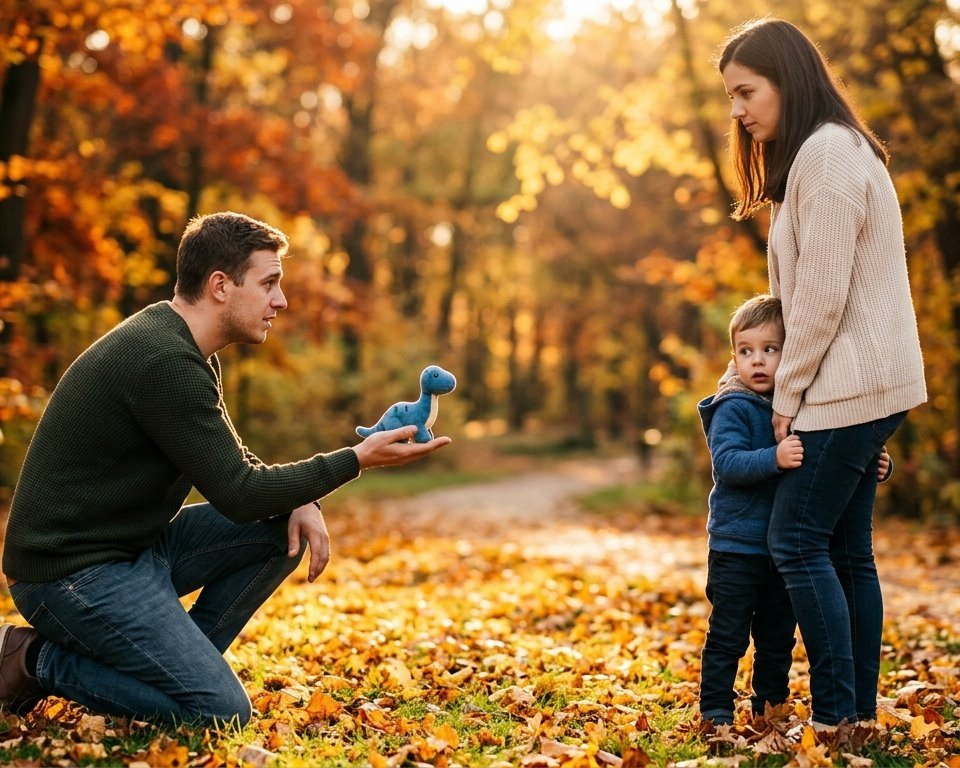
Careful meant a park, two Saturdays a month, Lena on a bench twenty feet away with a thermos and a stare that could strip paint. The first Saturday, Nico hid behind her leg and would not come out for twenty minutes, and I kneeled in the grass the whole time, holding a plush dinosaur with my palm open, saying absolutely nothing that asked anything of him. The second Saturday he took the dinosaur to inspect it and returned it for defects. The fourth, he allowed as how the dinosaur could stay, and by October we had a routine — same park, same bench, a growing herd of plush dinosaurs each assigned a geological era by a boy with his mother’s dark eyes and, it turns out, my exact laugh.
He called me Matt for almost a year, and I answered to it gladly, because it was a name he gave me out of his own mouth and no one can repossess that.
Change, I’ve learned, doesn’t announce itself. It accumulates, one ordinary Saturday at a time, until a Tuesday breaks. A Tuesday this spring, Nico fell off the climbing dome and scared himself worse than he was hurt, and when I picked him up he gripped my shirt with both fists and said, into my collarbone, half-asleep from crying: “Dad, don’t let go.” Then he blinked, as if the word had gotten out ahead of him, and I just said, “I’ve got dinosaurs older than that word. Use whichever one you want.” He uses both now. Matt when he’s showing off for other kids. Dad when he’s sleepy or scared or telling me secrets about dinosaurs. Both names are wages I earn weekly.
Lena and I will not be what we were, and I’m careful never to ask for that — some papers you sign away stay signed. But we are good at what we are: partners in the stewardship of one small dinosaur scholar. Last month she invited me in after a drop-off because it was raining, and I stood in her kitchen drying off, and she laughed at something I said — really laughed, not the careful version — and I did not mistake it for a door opening. I took it as what it was: a window, cracked, on a day it wasn’t raining inside.
My mother, for the record, writes Nico birthday cards now. It took her a year to say the words I was wrong to Lena. Some inheritances are debts, and we pay them down at whatever pace shame allows.
Here’s what I know now that the box didn’t: a test can tell you whose blood runs in a child. It cannot tell you who his father is. Blood is a fact you get in an envelope. Fatherhood is a practice you build out of Saturdays — kneeling in park grass, palm open, asking nothing, for as long as it takes.
I failed the easy test twice. I’m going to spend the rest of my life passing the hard one.