PART 1
At 39 years old, I had almost stopped believing that love was meant for me.
It wasn’t that I didn’t try.
I had loved before.
I had opened my heart.
I had imagined forever with people who promised they would stay.
But somehow, every relationship ended the same way.
Some people left when things became difficult.
Some people wanted the comfort of having someone beside them but never wanted the responsibility of building a life together.
And after enough heartbreak, I started wondering if maybe love was something that happened to other people.
Not me.
My friends would tell me:
“Don’t give up. The right person will come.”
But honestly, I stopped waiting.
I focused on my career.
I spent time with my family.
I built a peaceful life by myself.
Then one ordinary afternoon, everything changed.
My father invited an old friend over for dinner.
His name was Steve.
I had known of him for years.
He and my father had been friends since they were young men.
Steve was 48 years old, almost ten years older than me.
He was calm, respectful, and different from anyone I had dated before.
He wasn’t trying to impress everyone.
He didn’t talk about himself constantly.
He listened.
And that was something I noticed immediately.
During dinner, our eyes met across the table.
For a moment, everything became quiet.
It was strange.
Because I had known him as my father’s friend.
But that night, I saw him differently.
Not as someone from my father’s world.
But as a man.
After that evening, we started talking more.
At first, my father was surprised.
Then he became our biggest supporter.
“You know Steve is a good man,” my father told me.
“He has a good heart.”
And he was right.
Steve treated me with kindness.
He remembered little things.
He asked about my day.
He supported my dreams.
He made me feel safe.
Something I hadn’t felt in years.
Six months later, Steve proposed.
It wasn’t a huge, dramatic proposal.
There were no cameras.
No crowd.
Just the two of us sitting in the garden behind his house.
He held my hand and said:
“I don’t want to spend the rest of my life looking for someone. I already found her.”
I cried.
Because after years of disappointment, someone finally made me feel chosen.
Our wedding was simple.
But it was everything I wanted.
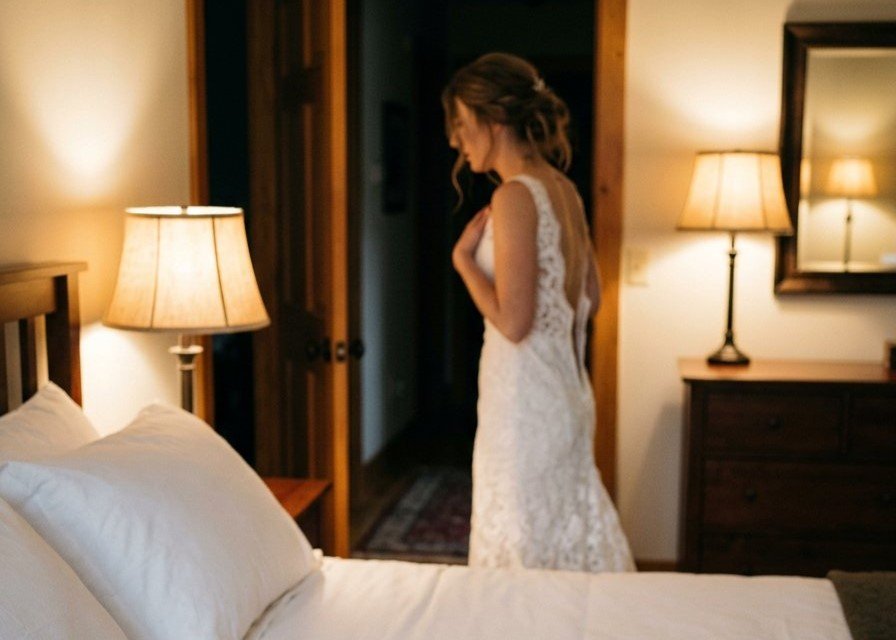
I wore the white dress I had dreamed about since I was a little girl.
My father walked me down the aisle.
Steve looked at me like I was the only person in the world.
For the first time in a long time, I felt like I had finally arrived at the place where I belonged.
After the ceremony, we went to Steve’s beautiful home.
It was quiet.
Warm.
Perfect.
I went to the bathroom to remove my makeup and change out of my wedding dress.
I looked at myself in the mirror.
A married woman.
A wife.
A woman who finally believed she had found happiness.
I smiled.
Then I walked back into our bedroom.
And my heart stopped.
Because sitting on the bed was a small wooden box.
I knew it wasn’t mine.
I slowly walked closer.
There was a note on top.
My name was written on it.
My hands began to shake.
I looked toward the bathroom door.
“Steve?”
No answer.
I opened the box.
Inside was an old photograph.
A photograph of my father.
Steve.
And a woman I had never seen before.
Behind the picture was a handwritten message.
The words made my entire body go cold.
“She deserves to know the truth.”
At that moment, Steve walked into the room.
He saw the box in my hands.
And the expression on his face changed.
The happiness disappeared.
The color left his face.
“What did you find?” he asked quietly.
I held up the photograph.
“Who is she?”
Steve sat down.
For a few seconds, he said nothing.
Then he whispered:
“She was someone your father and I both loved.”
My heart sank.
“What does that mean?”
Steve looked at the photo.
“Her name was Anna.”
I waited.
“She was my sister.”
I froze.
His sister?
Then why was my father in the picture?
Steve took a deep breath.
“Twenty-five years ago, Anna was in love with your father.”
I stared at him.
“My father?”
He nodded.
“They were going to get married.”
I felt like the room was spinning.
“My father was already married to my mother.”
Steve looked down.
“Yes.”
Silence filled the room.
I didn’t know what to say.
My father had always been the person I trusted most.
The person I thought could never hurt anyone.
“What happened?” I asked.
Steve’s eyes became wet.
“Your father made a choice. He chose his family. He ended things with Anna.”
“Then why didn’t I know about her?”
“Because she disappeared from his life.”
I looked at the photograph again.
“And you kept this all these years?”
“Yes.”
“Why?”
Steve looked at me.
“Because Anna was my sister. And because before she passed away, she asked me to make sure the truth was known someday.”
My breath caught.
“She died?”
Steve nodded.
“She became sick years later. Before she passed, she told me something.”
“What?”
“She said she didn’t hate your father. She just wished he had been honest.”
I sat down.
My wedding night had turned into something I never expected.
I thought I was discovering a betrayal.
But I was discovering a painful piece of the past.
Then Steve reached for another envelope.
“There’s more.”
Inside was a letter.
Not from Steve.
From Anna.
It was addressed to my father.
But he had never received it.
The letter wasn’t angry.
It was filled with sadness.
Anna wrote about forgiveness.
About moving forward.
About hoping everyone could someday find peace.
I read the entire letter silently.
And strangely…
I wasn’t angry.
I was heartbroken.
Not because my father had a past.
PART 2
Everyone does.
But because secrets can hurt people long after the original pain is gone.
That was the thought sitting in my chest while I held Anna’s letter in both hands and listened to the silence in our bedroom. It was supposed to be the first quiet room of our marriage. Instead it felt like a place where three different lives had just collided at once: mine, Steve’s, and the father I thought I knew better than anyone.
I read the letter again.
There was no bitterness in it. That was what unsettled me most. If Anna had written with rage, I could have understood it easily. If she had torn into my father or cursed the family he went back to, that would have fit the shape of the shock I was living through. But the letter was sad, gentle, and tired in a way that made everything feel heavier. She wrote like someone who had already spent years putting down a pain no one else had helped her carry.
Steve sat on the edge of the bed while I read. He did not rush me. He did not crowd me with explanations I had not asked for yet. The room had changed him too. A few minutes earlier he had been my husband on our wedding night, still wearing the happiness of the day on his face. Now he looked like a man who had finally opened a door he had been holding shut for years.
“Why tonight?” I asked him.
He looked at the wooden box before answering.
“Because there was never going to be a good night for this,” he said. “Only a true one.”
It was not the answer I wanted, but it was honest. I asked him whether my father knew he still had the photograph, or Anna’s letter, or the note she had left asking for the truth to be told someday. Steve said no. He told me he had kept all of it because he could not bear to throw away the last pieces of his sister’s life, but he also could not forgive himself if the whole story died with him too.
Then he said something I could not stop thinking about.
“She did not want revenge,” he said quietly. “She wanted the truth to outlive the silence.”
I did not cry right away. The shock was too clean for tears at first. I kept looking at the photograph instead. My father was younger in it, smiling in a way I recognized. Steve looked different too, leaner and less burdened. And Anna stood between them, not like a stranger I had missed, but like someone who should have existed in family stories and never did. The absence of her suddenly felt as real as the picture itself.
I thought about my mother too, though I barely let myself stay with that thought. The source I had in front of me did not tell me what she knew or did not know, only that my father had chosen his family. That single fact was enough to bruise everything around it. I did not need more detail to understand that this had not been some harmless past romance buried by time. It had reached forward across twenty-five years and landed in my marriage bed.
Steve told me more of what the source already suggested and nothing beyond it. Anna had become sick years after my father left her. Before she passed, she made him promise that one day the truth would be known. She did not ask him to destroy my father. She did not ask him to shame anyone publicly. She only asked that the silence end. Steve had carried that promise all this time, and when he looked at me across the bed that night, I could see what it had cost him to keep carrying it.
I asked him if he had almost kept the box hidden forever.
“Yes,” he said.
That one word hurt worse than a long defense would have. Because it meant he understood exactly what this night could break. It meant he had stood at the edge of the lie and recognized how easy it would be to choose comfort over honesty. And still, somehow, the box ended up on the bed.
We talked until the dark outside the windows started to thin. Not elegantly. Not romantically. In fragments. I asked the same questions more than once because my mind kept circling the same wound. Steve answered every one of them the same way each time. Calmly. Without trying to protect himself with polished language. By the time the sky went gray, I was exhausted, still dressed half in the remains of my wedding day and half in a truth I had never expected to carry.
“I need to talk to my father,” I said.
Steve nodded.
He did not try to stop me. He did not ask me to wait until the next day or after a honeymoon or after the story had softened into something more convenient. He simply said he understood.
The next morning, I called my father and asked him to come over.
When he walked through the door, I did not see the father who had walked me down the aisle the day before.
I saw a man about to meet the part of his own life he had buried.
I held up the photograph.
And for the first time in my life, I watched fear take his face.
PART 3
My father did not deny anything.
That shocked me almost as much as the box had.
I had spent the whole night bracing myself for excuses, selective memory, or the kind of wounded indignation people use when they want you to feel guilty for asking the question at all. Instead, he looked at the photograph, then at Anna’s letter, and something in him simply gave way.
“I wondered when you would find out,” he whispered.
Not if. When.
The word told me more than he probably meant it to. This had never been dead inside him. It had only been hidden.
I asked him to sit down. He did, but he kept his hands clasped so tightly that his knuckles went pale. He looked older than he had the day before at the wedding, as if one sleepless night had stripped away the familiar role I had always placed him in. He was not my steady father in that moment. He was a man facing the damage of something he had carried for years without bringing it into the light.
He told me about Anna.
Not every detail of their time together, because the source itself does not provide a long romance history, and I would not invent one. But he told me enough. They had loved each other. They had believed they were building toward a future. Then he made a choice. He chose the family he already had. He ended things with her and went on living as if the past could stay buried if he never gave it language again.
“That does not sound like a choice,” I said. “That sounds like damage.”
He looked down.
“I know.”
There was no self-defense in his voice. That almost made it worse. Anger is easier to hold when the other person keeps fighting for their innocence. But remorse leaves you with nothing to push against except the fact that what happened still happened.
I asked him why he had never told me. Not when I was grown. Not when Steve entered my life. Not even when he saw us getting serious. He said shame had a way of making cowards out of people long after the original sin. At first he had told himself he was protecting everyone. Later he told himself the right time had passed. Then the silence simply became part of the structure of his life, and he no longer knew how to speak without collapsing it.
“You trusted Steve enough to bring him into our house,” I said. “But not enough to believe the truth could survive dinner?”
That landed. I could see it in his face.
He said Steve had every right to hate him. He said he would understand if I hated him too. I told him hate was not what I felt. Hate would have been cleaner. What I felt was grief for the man I thought I knew without complication.
Then he said the line that stayed with me longer than anything else from that morning.
“I was young,” he said. “But being young doesn’t mean you don’t hurt people.”
The room went still after that.
Because it was true. Not in the abstract way people say true things to escape harder ones. It was true in the exact shape of what he had done. Youth had not erased consequence. Time had not erased it either. It had only delayed the moment when the cost would finally be spoken out loud.
I showed him Anna’s letter. He read it slowly, one page at a time, and by the end he was crying without trying to hide it. She had written about forgiveness, about peace, about moving forward. Not forgetting. Not pretending. Just refusing to let pain be the only thing left behind. Watching him read it did something strange to my anger. It did not remove it, but it changed its temperature. I stopped wanting punishment and started wanting clarity.
When he finished, he folded the pages with care and set them back down on the table as if they still belonged first to her.
“I should have been honest,” he said.
“Yes,” I answered.
“And Steve should not have had to carry this alone.”
“Yes.”
He nodded once, like a man sentencing himself more than defending himself. There was nothing dramatic about it. No request to be absolved. No desperate effort to reclaim his image. Just a tired admission that the silence had done what silence always does when it is fed long enough: it spread the hurt outward until it touched people who had not even been there when it began.
After he left, I sat with Steve at the same table and realized the center of my wedding night had shifted. I was no longer asking only what my father had done. I was also asking what kind of marriage begins with a truth this heavy and whether honesty, arriving this late and this brutally, could still be a form of love.
I did not know the answer yet.
But I knew the question had become the turning point.
PART 4
The days after that were not cinematic.
No one stormed out of the marriage. No one made a dramatic declaration and solved the hurt in one clean conversation. What we had instead were many conversations, just as the source says. Difficult ones. Repetitive ones. The kind that return because one honest answer rarely cancels what a secret has already done to the room.
I kept coming back to the same ache. Steve had told me the truth, yes. But he had told it on our wedding night, after vows, after my father walked me down the aisle, after I had stepped into a future without knowing the past sitting underneath it. He said he understood why that felt cruel. He said he had hated himself for the timing too. But Anna had asked him to make sure the truth was known someday, and the closer he got to marrying me, the less he could pretend someday meant forever.
There was no elegant answer to that either.
If he had told me before the wedding, the day would have been shattered in a different way. If he had told me after, I might have wondered whether he had only spoken because marriage made the truth safer for him. If he had never told me, then I would have spent my life beside a man who let my father’s silence become part of our marriage. Every version had a wound in it. The only thing I could weigh was which wound I could live with.
I began to understand, slowly and against my own resistance, that Steve had chosen the version that left him most exposed. He had put the box where I could not miss it. He had attached no excuse to it. He had answered what I asked and accepted that I might never forgive the timing. That did not make the night painless. It made him accountable.
My father and I spoke too, but those conversations were harder. Not because he lied after the truth surfaced. He did not. He answered what I asked. He admitted regret. He admitted harm. But there was no way around the fact that his silence had lived inside my entire life without my consent. That kind of realization does not heal because the guilty person finally becomes honest. It only stops deepening.
Years passed.
Not many details are given in the source about those years, and I stayed inside that boundary. But I can say what the source itself allows me to say: my wedding night changed the marriage, and the difficult conversations that followed did not destroy it. They made it stronger because they forced everything unspoken into language. Steve and I did not get a perfect beginning. We got a true one, and that truth kept testing us until we learned what it actually meant to remain.
My father grew older. Time did what it always does. It softened some things from the outside and sharpened others from within. When I looked at him after that year, I could no longer see only the father who loved me well in so many ways. I also saw the younger man who had hurt a woman, burdened her brother, and mistaken silence for responsibility. Both men lived in him. I had to learn how to stand in front of both.
Then, a few years later, he became very still in the way people sometimes do near the end. The source says he passed away peacefully. Before that happened, he asked to speak with me alone.
I went to him.
He reached for my hand.
And before I said a single word, I knew he was about to ask for something he had no right to demand and every reason to hope for anyway.
PART 5
“I’m sorry for the things I did wrong,” my father said.
There was no speech around it. No attempt to narrate himself as noble in regret. Just the apology itself, plain and stripped of performance. By then he did not have the energy for anything else, and maybe that was why I could hear it clearly. He was not trying to rescue his image. He was trying to leave without one more silence between us.
I squeezed his hand.
“I know,” I told him.
That was the answer the source gives, and it was enough. Not grand forgiveness. Not denial of what happened. Just an acknowledgment that he had finally named what he should have named years earlier. After that he said one more thing.
“And I’m grateful you found happiness.”
I smiled.
“Me too.”
When he passed, I grieved him honestly, which was different from grieving him innocently. I grieved the father who had loved me, supported me, and believed Steve was a good man. I also grieved the illusion that love inside a family automatically means complete honesty. Those two griefs had to live side by side. There was no other truthful way to carry him.
What remained after his death was the marriage that had begun under the weight of a wooden box and an unread letter. Looking back, I can say what the source itself says without turning it into a sermon: my wedding night was not ruined. It was changed. Love had brought me to Steve, but honesty was what kept me there once the room became difficult.
Steve and I went back over that night more than once in the years that followed. Not because we were trapped in it, but because beginnings matter, especially the broken ones. Each time I asked him some version of the same question—whether he had ever been tempted to hide the box forever—he gave me the same answer. Yes. He had been tempted. Deeply. Because hiding it would have been easier on him, easier on my father, easier on the wedding, and easier on every fragile hope we had for the future.
But easy was never the same as clean.
The truth would still have been there, waiting underneath the life we built. Anna would still have been erased from the story. My father’s silence would still have been shaping my marriage from the shadows. And Steve would still have known he had chosen comfort over honesty on the first night I trusted him with everything.
That is why, in the end, the box mattered more than the shock it carried. It was not simply evidence of an old betrayal. It was proof that my husband understood something my father had learned too late: the truth costs less before the silence grows roots.
He could have hidden the box forever.
He could have protected himself.
Instead, he chose the truth.
And that showed me the kind of man I had married.