My sister announced in the family chat that I was banned from the reunion and warned everyone not to tell me where it was.
She wrote it the way she wrote everything cruel: clean, practical, and smug.
Nobody sends Skyla the address.
She is not invited.
If anyone tells her where we are, don’t bother coming either.
We are keeping this drama-free for Mom.
Drama-free.
I stared at that line until I started laughing.
Not because it was funny.
Because sometimes the only thing your body can do with that kind of humiliation is turn it into a sound that doesn’t look like pain.
Then I tapped the location pin attached under her message.
And when the map opened, I laughed so hard I had to cover my mouth.
They were going to my beach house.
The house sat in Seabrook Cove, Georgia, in a strip of private oceanfront homes where every driveway curved through dune grass and sea oats before opening to the Atlantic.
Mine was the dusty-blue three-story one with bright white trim, a wraparound deck, and windows so big the whole front of the house turned gold at sunset.
I knew every inch of it because I had rebuilt it.
I bought it through my LLC two years earlier, after a wrecked marriage and a worse year had left me with the kind of money that looked lucky from the outside and felt expensive from the inside.
The place had been neglected when I found it.
Salt damage.
Rot under the deck.
A kitchen that smelled like mildew.
Bad wiring.
Ugly bathrooms.
Everybody told me I was stupid for taking it on.
I spent six months proving them wrong.
I picked the siding color myself.
I chose the white trim because it made the house look clean without feeling cold.
I had hand-scraped oak installed downstairs, and I stood in the tile yard for three hours deciding on the exact marble for the island because I wanted the kitchen to feel like the center of a life I was building on purpose.
I commissioned a giant abstract oil painting from an artist in Savannah for the living room wall.
I bought linen drapes that moved like water when the doors were open.
I had custom locks installed, cameras placed at every exterior entry point, and a smart system tied directly to my phone.
The house was mine in every way that matters.
My family knew I owned property.
They just didn’t pay enough attention to my life to know which property was which.
That had always been the story with them.
My older sister Bridget liked attention more than truth.
My brother Kyle liked comfort more than loyalty.
My father preferred the path of least resistance, which usually meant agreeing with whichever woman in the room was angriest.
And my mother, Linda, liked power in forms she could display: a better table, a nicer neighborhood, a prettier vacation, the right people seeing her where she believed she belonged.
For years, I kept trying to earn a softness from them that never came.
When I was younger, I thought if I became more useful, more patient, less sensitive, less blunt, less myself, they would finally relax around me.
Instead, every version of me became something to criticize.
Too ambitious when I worked late.
Too private when I stopped explaining myself.
Too proud when I bought my own things.
Too dramatic when I reacted to anything cruel.
Too quiet when I didn’t.
My mother had a favorite line for me.
Skyla always has to make things about Skyla.
It was a perfect sentence because it worked no matter what I did.
If I protested, I was dramatic.
If I cried, I was manipulative.
If I left, I was selfish.
If I stayed, I was exhausting.
By the time Bridget removed me from the family reunion plans, I was too tired to perform hurt in a way they would enjoy.
I had been left out in smaller ways before.
Lunches.
Group photos.
Birthday dinners that somehow got scheduled on nights they knew I was out of town.
But this was the first time they had said it plainly.
You are banned.
Even then, some old part of me might have broken and gone begging if she had not attached that pin.
The moment I saw the location, something cold and clear settled into place.
I did not text back.
I did not warn them.
I changed the front door code remotely to a number I knew my mother would never forget.
198507.
My birthday: July 5, 1985.
Not because she cherished it.
Because for thirty years she had found ways to mention that my birth had ruined her figure, interrupted her career plans, exhausted her, trapped her, aged her.
She had repeated that date so many times in resentment that it lived in her memory more securely than love ever had.
Then I drove to Seabrook Cove and parked across the road in a silver rental sedan with tinted windows.
I could have called the sheriff before they arrived.
I could have met them at the gate.
I could have locked them out and watched them unravel on the porch.
But I knew my family.
If I blocked them before they entered, they would rewrite the entire scene.
They would say I had misunderstood.
That they were surprising me.
That the booking had been mixed up.
That they were just stopping by to look.
There was always a story ready when they needed one.
So I let them commit to the lie.
The Georgia heat that day was obscene.
Ninety degrees, maybe more, with humidity so thick it felt like the air had weight.
The engine in the rental was off.
The air conditioner had given up minutes earlier, and sweat gathered at the base of my neck and between my shoulder blades.
I didn’t care.
The discomfort kept me sharp.
From behind the windshield, I watched the parade arrive.
Three large SUVs rolled into my shell driveway in a little cloud of white dust.
My mother climbed out of the lead car first, draped in a floral caftan and a broad straw hat, already moving like a hostess making an entrance.
She clapped once and started directing people before both rear doors had even opened.
Kyle hauled coolers from the back.
My father reached for folding chairs.
Two cousins came with tote bags and beach umbrellas.
Bridget got out of the second SUV holding her phone high, filming the facade of my house with the ocean glinting behind it.
I knew exactly what she was doing.
She was building content.
A luxury family getaway.
Soft light.
Blue water.
Wealth without labor.
The kind of footage that made followers imagine private money and easy summers.
My family loved the appearance of privilege far more than the cost of it.
They moved up the stone path toward the porch with complete confidence.
Nobody looked around for a property manager.
Nobody checked a listing.
Nobody waited for a call.
My mother went straight to the keypad like she had every right in the world.
She entered the code.
1-9-8-5-0-7.
My birthday.
The lock hummed.
The keypad flashed green.
A cheerful chime rang through the porch.
For half a second they all froze, almost surprised that brazen entitlement had worked.
Then they erupted.
Kyle smacked my father’s hand.
Bridget squealed and rushed inside.
My mother turned back toward the driveway and waved the last of them forward with that imperious little tilt of her chin I had hated since childhood.
Come on, come on, she mouthed, as if she were opening a country club to invited members.
Through the glass, I could see them fan out through my foyer and into the living room.
The giant painting caught the light.
The oak floors shone.
The kitchen glimmered beyond the entry hall.
Bridget spun in the center of the room with her phone lifted, filming the chandelier, the ocean view, the marble island.
My mother touched the back of one of the bar stools and pointed at something by the stairs.
I didn’t need audio to know what she was doing.
Don’t scratch the floors.
Set the bags over there.
Take your shoes off.
Be careful with the paint.
She was managing my home with the authority of a woman who had never paid one tax bill on it.
PART 2
I let them settle in.
I let them stack drinks in my refrigerator.
I let them open cabinets.
I let them drag ice chests toward the deck.
I let Bridget post from my upstairs balcony.
I let my mother stand at my kitchen island pouring wine into glasses as if she were rewarding people for choosing her side.
I did all of that for one reason: I knew exactly how my family handled interrupted entitlement.
They rewrote it.
If I had met them at the gate, they would have called it a misunderstanding.
If I had locked the door, they would have said I was unstable.
If I had texted the group chat, Bridget would have turned it into a story about me ruining the reunion and punishing our mother for wanting a peaceful weekend.
They never entered a room without an alibi already in their pocket.
So I let them build one too big to carry.
Twenty minutes after they arrived, I made the call I had already prepared. The deputy at the sheriff’s office had asked three efficient questions earlier that day—whether anyone was violent, armed, or family. That last one almost made me smile because yes, they were family, and that was exactly why I wanted law in the room before emotion had a chance to start editing facts.
When the patrol vehicle turned into the road beside the dunes, my pulse didn’t rise. It settled.
No siren.
No lights.
Just a slow official glide that changed the meaning of everything the moment it touched my driveway.
People came to the windows.
My mother stepped onto the porch first with a smile already prepared, the same smile she used at restaurants when something was late and she wanted the server to feel both charmed and beneath her. Bridget followed with a plastic cup in one hand and her phone in the other. Kyle came out looking irritated in advance, as if being questioned in someone else’s house were a personal inconvenience rather than the natural consequence of trespassing.
The deputy took in the open door, the coolers, the beach towels, the bare feet, and the general atmosphere of inherited confidence. Then he asked the only question that mattered.
Which one of you can identify the legal owner of this property?
No one answered.
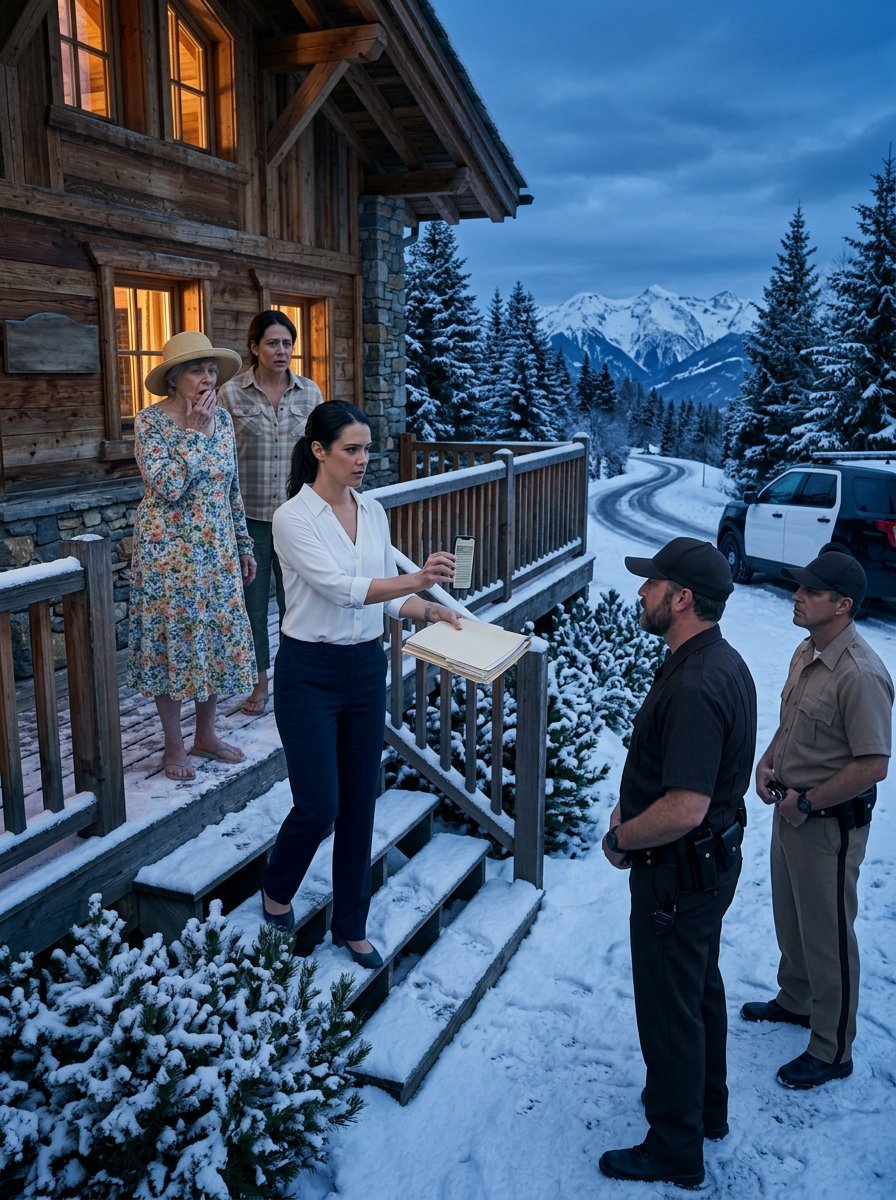
That was when I got out of the rental.
The heat hit me hard enough to feel solid. Gravel crunched under my sandals as I crossed the road carrying a leather file and my phone. Every head turned toward me at once. My mother’s face changed first—not into guilt, but into outrage, as if my presence at my own house had violated etiquette.
“Skyla?” she said.
Even then, offended.
I climbed the steps and stopped beside the deputy.
“This is my property,” I said. “Owned through Morales Coastal Holdings LLC. I filed the complaint.”
Then I handed over the file.
Inside were copies of the recorded deed, the LLC registration, my driver’s license, insurance records tied to the property, and recent tax documents. On my phone, I opened the smart-lock app showing the access logs. The front door had been unlocked at 12:14 p.m. with a temporary code generated from my administrator account. I created it at 9:03 that morning.
The deputy studied the papers the way competent people study drama: carefully, without being impressed by it.
My mother lunged for moral ground immediately.
“You did this on purpose?”
I looked at her.
“You banned me from the reunion and brought everyone to my house,” I said. “Yes. I let you in.”
That landed harder than shouting would have because everybody on that porch knew it was true.
Bridget tried to hide behind the oldest family excuse of all.
“We’re family.”
The deputy looked up from the papers.
“Family doesn’t override title ownership, ma’am.”
I almost liked him for that.
Then Bridget’s phone lit up.
A motion notification.
I recognized it before she did. The interior cameras had activated the second the house registered occupancy under an owner-away setting. She tapped the alert by reflex, and the clip auto-played with sound.
My living room appeared on her screen from the angle above the bookshelves.
My mother walking in first.
Kyle dropping a cooler by the stairs.
Bridget panning the room with her own phone.
My father lingering near the door.
And then my mother’s voice, clear as broken glass:
“See? I told you she’d never know. This place is perfect.”
The porch went still.
Then Kyle’s voice on the video: “You sure this is legal?”
And my mother answering, “By the time Skyla finds out, the weekend will be over.”
The deputy held out his hand for the phone. Bridget surrendered it without protest. He replayed the video. Calmly. Completely. In front of everyone.
My father shut his eyes.
One cousin set her drink down like it had suddenly become too embarrassing to hold.
Bridget whispered, “Mom…” but there was no support left in the word.
My mother made one last attempt.
“This is absurd. You’re humiliating us over a misunderstanding.”
“It stopped being a misunderstanding when you told people not to tell me where my own house was,” I said.
Then the deputy changed tone.
“All unauthorized occupants need to gather their belongings and exit the residence. Now. If the owner wants trespass warnings issued, I can do that here.”
That was when confidence finally broke.
PART 3
The family that had marched into my beach house like a parade suddenly couldn’t look each other in the eye.
My mother turned to my father as if he might finally save her. He didn’t. Kyle muttered that the whole thing was insane, but his anger sounded thin now—less outrage than embarrassment curdled under heat. Bridget kept looking down at her phone, probably calculating what she had already posted, who had already seen it, and whether deleting anything now would only make the lie look worse.
I recognized the old version of myself hovering somewhere behind my ribs. She would have stepped in then. She would have softened the room, told everyone to calm down, found some graceful way to save them from the exact shape of what they had chosen. She would have confused mercy with self-erasure and called it maturity.
She stayed quiet.
The new version stood still.
They filed back inside to collect their things. The deputy came with me into the foyer while the house filled with a very different set of sounds than the ones that had greeted their arrival.
Coolers closing.
Cabinet doors shutting.
Wheels bumping over the oak floor.
The same people who had poured wine and claimed space with their shoulders now touched everything as little as possible, as if contact itself might become evidence.
Bridget came downstairs carrying a garment bag and a makeup case. She would not meet my eyes. Kyle hauled the coolers back toward the porch with his jaw clenched so tightly I thought he might crack a tooth. My father gathered the beach chairs and muttered “sorry” once without specifying whether it was to me, to the deputy, or to the version of himself that never seems to arrive until too late.
My mother lingered longest.
She stood in the kitchen staring at the marble island, the range, the clean white trim, the afternoon light moving across surfaces she had already begun treating as proof of her own taste. When she turned toward me, her voice came out lower.
“You would do this to your own mother?”
For most of my life, I answered the wrong version of that question.
This time I answered the right one.
“You did this to yourself.”
She flinched. Maybe because I had never said anything that plain before. Maybe because plain truth is often harder for people like her to survive than anger. Anger they can dismiss. Precision is another matter.
Outside, the deputy asked each adult for identification and began issuing written trespass warnings at my request. Returning without my consent, he explained, could lead to arrest. That explanation sobered the porch better than the sea air ever had. My mother signed hers so hard the pen scraped. Bridget signed in silence. Kyle rolled his eyes and signed anyway. My father’s hand shook.
Nothing about the scene felt triumphant.
It felt exact.
That mattered more.
Because what I wanted was not humiliation for humiliation’s sake. I wanted proportion. They had used family as a solvent for boundaries so long they no longer believed boundaries existed. Now a deputy, a deed, a lock log, and their own words on video had to do the teaching I spent years trying to earn softly.
Even then, the lesson was not complete. My mother made one more attempt before getting into the SUV.
“Enjoy the house,” she said bitterly.
The line was almost childish after all that effort.
“I plan to,” I answered.
But the story was not over just because the vehicles started backing down the driveway.
My father texted before the dust had fully settled.
I should have said something sooner.
Bridget followed a minute later.
Please don’t post anything.
Those two messages told me everything about the hierarchy they still lived inside. My father wanted absolution without confrontation. Bridget wanted reputation preserved without accountability. Neither one asked the only question that would have mattered if they had actually understood the day.
Are you all right?
I did not answer either of them.
Instead, I watched the last SUV disappear past the dune grass and let the silence come all the way back.
PART 4
After the deputy left, I locked the front door from my phone and walked through the house room by room.
The shift inside it was immediate. A lemon wedge sat abandoned on the kitchen counter beside a half-open bag of chips. One of the bar stools had been turned crooked. A damp ring from someone’s drink marked the marble near the sink. Upstairs, a guest-room curtain had been yanked askew. Tiny things. Easy things. But each one held the same message: they had arrived prepared to consume whatever I built, so long as they could do it before I showed up with proof.
I cleaned in silence.
Not because the house needed much work.
Because restoring it to myself felt necessary.
Straightening a curtain. Wiping a ring from stone. Returning a stool to its exact place. The acts were ordinary. The meaning wasn’t.
When I finished, I took a glass of water to the deck and sat facing the Atlantic. The sea oats moved under the wind. Down the beach, somebody laughed, far enough away that it sounded harmless. My phone buzzed once more. Another text from my father. Then another missed call from Kyle. Then a longer message from a cousin saying she hadn’t known the house was mine and asking me not to be too hard on everyone because “families get confused.”
No.
Families do not get confused into location pins, secret codes, content filming, and open plans to use someone’s property before they can stop you.
Entitled people do that.
And they usually rely on family language to make the theft sound softer.
By sunset, Bridget had already started deleting posts. Linda had called two different relatives claiming I baited them into a trap. Kyle, I later learned, told people he thought the house belonged to some friend of Bridget’s and never asked questions because he “didn’t want to get involved.” That was probably true. Not caring enough to ask is its own kind of involvement in families like mine.
I stayed on the deck until the sky turned lavender. Then I took one photograph of the ocean and posted it with a caption simple enough to travel on its own:
Nothing is more peaceful than being exactly where people hoped you wouldn’t be.
No tag.
No address.
No family names.
I didn’t need them.
By then the story already belonged to me.
The old Skyla would have worried all night about whether the post was too sharp, whether the silence was too loud, whether refusing to soothe everyone after they trespassed into her house made her the difficult one after all. That version of me was still there in traces. But she was no longer in charge.
And the house behind me—glowing warm through the glass, every lock answering to me, every room returning to the shape I chose—was proof that she didn’t need to be.
PART 5
By the time darkness settled fully over Seabrook Cove, the house no longer felt invaded.
It felt mine again.
That was the real end of it. Not the trespass warnings themselves. Not my mother’s face when the camera clip played. Not Bridget’s panic about posts or Kyle’s thin anger or my father’s late apology. Those were all consequences. Necessary ones. But the deeper turn happened on the deck, with the ocean in front of me and the house lit behind me, when I finally understood that exclusion had only ever been powerful while I kept acting as if I needed to be re-invited.
I didn’t.
The power was never in yelling louder than them.
It was in knowing what was mine.
My work.
My name.
My house.
My peace.
For years, I had mistaken access for affection. If they invited me, I mattered. If they included me, I still belonged. If they withheld those things, I must have done something to deserve the coldness. That is what manipulative families train you to believe. They make belonging feel conditional and then act generous whenever they briefly stop punishing you.
The beach house broke that pattern because it made the arrangement visible. They did not only want distance from me. They wanted the good parts of my life without me in them. The view. The marble. The deck. The story. The effortless summer photo with no evidence of the woman who actually earned any of it.
Once I saw that clearly, something in me stopped grieving the wrong thing.
They had never been keeping me out of anything worth having.
The evening deepened. Lights came on along neighboring decks. Somewhere farther down the shore, a dog barked once and then gave up. Inside, the house hummed with its usual systems—the quiet mechanical steadiness of a place designed to hold. I walked back through the rooms one more time before bed, touching nothing, only looking. The painting in the living room. The clean line of the staircase. The island where my mother had stood pouring wine like a queen for guests who had mistaken theft for hospitality.
Everything was exactly where I wanted it.
That mattered more than revenge.
Because revenge still centers the people who wronged you.
What I felt instead was recovery.
And recovery lasts longer.
Before I went upstairs, I checked the locks once more from my phone. Green across the system. All secure. I set the device on the nightstand and left my father’s message unanswered. Maybe one day I would respond. Maybe I wouldn’t. Accountability does not always arrive on the timeline other people suddenly find convenient.
That night, for the first time in a very long while, I did not feel like a ghost circling somebody else’s version of family.
I felt visible.
I felt solid.
I felt at home.