Ifound the earring on a Tuesday afternoon while cleaning out Martin’s car.
We were trading in the old sedan at the end of the week, and my husband believed “cleaning the car” meant removing the coffee cup from the console. I knew the dealership would find six years of receipts, cough drops, maps, and petrified french fries unless I intervened.
The earring lay beneath the rear passenger seat, caught where the carpet met the metal rail.
It was a delicate gold drop with a tiny amber stone. Not costume jewelry. Not mine.
I sat back on my heels and held it against my palm.
Martin and I had been married for thirty-four years. He was not charming with strangers. He forgot to replace empty toilet rolls and considered parsley an unnecessary extravagance. He was also the man who warmed my side of the bed with a heating pad when my back hurt and called me every evening he worked late.
Until that year, I had never searched his pockets, checked his phone, or wondered whether his life contained a room to which I had no key.
But the previous three months had been strange.
He had begun disappearing on Thursday afternoons. He said he was meeting clients, though he had mostly retired from the accounting firm. Twice I caught him ending a call when I entered the room. Our bank statement showed parking charges at St. Vincent Medical Center, which he explained as lunch with an old colleague who worked nearby.
At night, he lay awake facing the ceiling.
“Something on your mind?” I would ask.
“Just getting old,” he would say.
I wanted to believe him because trust, after enough years, becomes the floor beneath your life. You do not inspect every board. You simply walk.
I put the earring in my pocket and finished cleaning the car.
That evening, I invited Martin’s mother to dinner.
Ruth lived fifteen minutes away in a brick bungalow filled with houseplants and clocks that chimed at different times. At seventy-nine, she still drove herself to the library, corrected restaurant menus with a pencil, and wore lipstick to collect the mail.
When I called, she hesitated.
“Tonight?”
“Unless you have plans.”
“No. No plans.”
Martin looked startled when I told him.
“Mom’s coming?”
“She is.”
He studied my face, but I gave him nothing.
I roasted chicken with lemon and rosemary. I set the table with the blue-rimmed plates we received as a wedding gift. Then I placed the gold earring in my pocket and waited.
Ruth arrived at six carrying a grocery-store pie. She removed her coat in the hallway, turned toward me, and tucked a strand of silver hair behind her ear.
That was when I saw it.
One gold drop earring with a tiny amber stone.
Only one.
Relief reached me first, absurd and immediate. The earring did not belong to a stranger. It belonged to Ruth.
Then another question took its place.
Why had my mother-in-law been in the back seat of Martin’s car, and why had both of them hidden it?
We made small talk through the salad. Ruth asked about the trade-in. Martin discussed weather with the intensity of a man negotiating a treaty. Neither looked at the other.
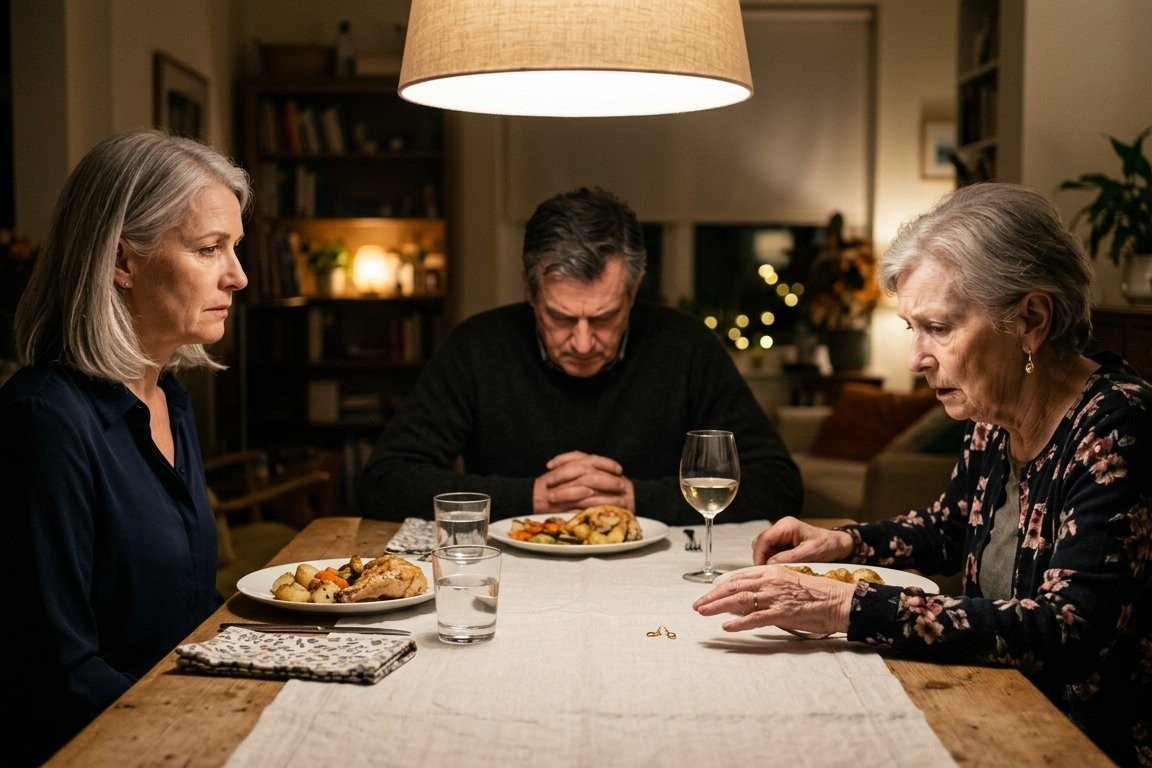
When I served the chicken, I took the matching earring from my pocket and set it beside Ruth’s plate without a word.
She picked it up.
Her face turned white.
Then she looked at Martin.
He lowered his eyes to the table.
The silence seemed to pull every sound from the room—the refrigerator, the traffic outside, even the small click of the dining-room clock.
“What is going on?” I asked.
Ruth closed her hand around the earring. “He didn’t tell you.”
“Tell me what?”
She looked suddenly much older than she had in the hallway.
“I have pancreatic cancer,” she said. “It has spread to my liver. The doctor thinks Christmas would be ambitious.”
It was April.
For several seconds, the sentence meant nothing. I saw the words but could not arrange them into reality.
“No,” I said.
Ruth gave a small, exhausted shrug. “That was my first response too.”
I turned to Martin. “How long have you known?”
His voice was barely audible. “Eleven weeks.”
The Thursday afternoons. The hospital parking. The calls that ended when I entered.
“You drove her to appointments.”
“Yes.”
“And you lied to me.”
Ruth reached across the table. “I made him promise.”
I pulled my hand away before she could touch it.
“You made my husband keep your terminal illness from me?”
“I didn’t want everyone looking at me as if I were already gone.”
“I’m not everyone.”
“No,” she said. “You’re the person who would have taken over.”
The words stung because they contained enough truth to be cruel. I organized things when frightened. After my own mother’s stroke, I had built medication charts, interviewed nurses, and turned grief into binders. Ruth had watched me do it.
“I would have helped.”
“I know.” Her eyes filled. “I wasn’t ready to need help.”
I looked at Martin. “And you agreed to this?”
He raised his head. His face was gray with fatigue.
“I asked her every week to tell you.”
“But you didn’t.”
“She’s my mother, Elaine.”
“And I’m your wife.”
“I was trying to honor what she wanted.”
“You were letting me build an ordinary life inside a lie.”
Ruth began crying soundlessly. Martin reached toward her, then stopped, trapped between us exactly where he had placed himself.
I stood so quickly my chair scraped the floor.
“I need air.”
I walked into the garden without a coat. The April evening was cold, and the rosemary near the steps released its scent beneath my shoes. Through the window I could see Martin sitting beside his mother. His shoulders shook.
I had spent the afternoon preparing myself for betrayal. I had imagined another woman, another life, some humiliating secret that would divide our marriage into before and after.
This was worse.
There was no one to hate.
Only death, approaching quietly while the people I loved protected it with silence.
Martin came outside ten minutes later and draped my cardigan over my shoulders.
“I’m sorry,” he said.
I stared at the dark garden. “Were you ever going to tell me?”
“She had another scan scheduled Friday. I told her after that, with or without permission.”
“You should have told me eleven weeks ago.”
“I know.”
“You don’t get to decide what pain I can handle.”
“I know.”
His voice broke on the second word.
I finally looked at him. He had lost weight. There were purple shadows under his eyes. All the signs I had interpreted as guilt belonged to grief.
“How have you been carrying this alone?” I asked.
“Badly.”
That did not erase the lie. It did, however, let me see the man beneath it.
We returned to the table. The chicken was cold. Ruth still held the earring.
“I am angry with both of you,” I said. “I will probably be angry tomorrow. But tonight we need the whole truth.”
So Ruth told me.
The pain had begun in January. Her doctor found a mass. Surgery was not possible. Chemotherapy might buy time but would not cure her. She had removed her earrings before an MRI and dropped one while climbing into the back seat because the front was crowded with Martin’s file boxes.
“I kept meaning to ask him to look,” she said.
“You might have saved us an unusual dinner,” I replied.
To my surprise, she laughed. It became a cough, then tears. I moved my chair beside hers and held her until she could breathe again.
The next morning, we made rules.
Ruth could decide which treatments she accepted. She could say no to visitors, casseroles, and conversations about positive thinking. But she could not ask one member of the family to lie to another about her condition.
Martin would attend appointments, and so would I when invited. We would not discuss Ruth as if she were absent while she sat in the room. We would ask before helping.
Most importantly, we would stop treating truth as something that became kinder when delayed.
The months that followed were painful, ordinary, and unexpectedly beautiful.
Ruth tried chemotherapy twice and stopped when the sickness stole every usable hour. She wanted time in her garden, not more time beneath fluorescent lights. We respected that.
She taught our granddaughter Sophie how to make apple pie without measuring cinnamon. She labeled the plants in her bungalow, though half the labels included insults such as FUSSY BEGONIA and THAT RIDICULOUS FERN. She gave away her clocks one by one because, she said, “No dying woman should be surrounded by that much ticking.”
Some days she was frightened. Some days she was furious. Often she was funny.
At the end of May, she handed me a small velvet box.
Inside were the gold earrings.
“They were Paul’s last anniversary gift to me,” she said, meaning Martin’s father, who had died eight years earlier. “Amber is supposed to hold sunlight.”
“I can’t take these.”
“You can. I am giving them, which is different from dropping one in a car.”
I smiled despite myself.
“Wear them when you need to remember that suspicion is not the same as knowledge,” she said. Then her expression sharpened. “But also remember that husbands should not keep eleven-week secrets.”
From the kitchen, Martin called, “I can hear you.”
“You’re meant to,” she replied.
Ruth lived until November.
Christmas was indeed too ambitious, but she reached Sophie’s birthday and a final autumn when the maple outside her window turned the color of fire. She died at home with Martin on one side of the bed and me on the other. The room smelled of lavender cream. One of her ridiculous clocks chimed four though it was nearly six.
After the funeral, Martin and I entered counseling.
Grief had not created the weakness in our marriage; it had only illuminated it. Martin believed love meant carrying burdens without complaint. I believed competence entitled me to every fact immediately. We had to learn that privacy and secrecy were not the same, and neither were help and control.
Trust did not return in one grand conversation. It returned through smaller things. Martin told me when he was afraid instead of saying he was tired. I asked whether he wanted solutions before offering them. We practiced telling uncomfortable truths while they were still small enough to sit between us.
A year later, we traded in the sedan at last. The salesman walked around it with a clipboard while Martin and I emptied the glove compartment.
“Check beneath the back seat,” I said.
“I have checked it three times.”
“Check again.”
He found a cough drop and held it up triumphantly.
“No secret life?” I asked.
“Only cherry menthol.”
I wore Ruth’s earrings that day. In the dealership window, the amber stones caught the November light and glowed warmly against my hair.
The single earring had once seemed like evidence that my marriage contained another woman.
It did.
She was the woman who had raised my husband, challenged me, irritated me, loved me, and been terrified of vanishing beneath everyone’s care. Her secret wounded us because time was the one thing we could not recover.
But the earring also gave us what silence had been stealing: the months we still had.
I keep the pair in their velvet box beside a photograph of Ruth in her garden. When I wear them, I remember the dinner table, the cold chicken, and the sentence that divided our lives.
I also remember what came after—the rules, the laughter, the labels on the plants, and the courage it took for three frightened people to stop protecting one another from the truth.
Gold does not hold sunlight forever.
But sometimes it carries enough to lead us out of the dark.