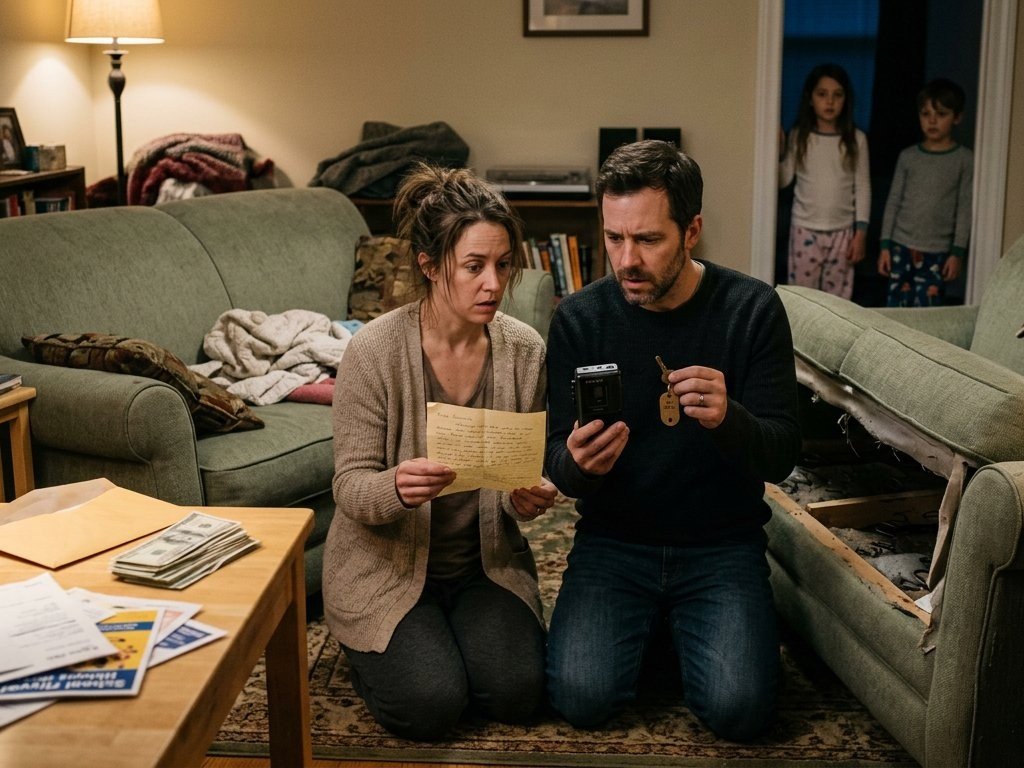
The couch cost seventy-five dollars and smelled faintly of lavender, dust, and somebody else’s winters.
Leah found it at an estate sale across town. Its green upholstery was faded along the arms, but the frame was solid, and it was the first piece of furniture we had bought since moving into the apartment. Until then, our children watched movies from sleeping bags on the floor.
“It has character,” Leah said.
“It has a dent shaped like an elderly person,” I said.
“That is character.”
We laughed as we wrestled it through the doorway. Laughter had become valuable that year.
My hours at the warehouse had been cut. Leah’s job at the dental office covered groceries and most of the rent, but not both at the same time. Our twelve-year-old car had died in a supermarket parking lot three days earlier. Max needed a scientific calculator for school. Ruby’s sneakers were separating at the toes, though she insisted she liked the way they “talked” when she walked.
We were not starving. We were simply one broken appliance away from becoming afraid of the mailbox.
That night, I tipped the couch forward to tighten a loose leg. Something crackled beneath the black fabric covering its underside.
I reached through a tear and pulled out a thick cream-colored envelope.
Inside were one hundred crisp hundred-dollar bills.
Ten thousand dollars.
Leah and I sat at the kitchen table with the cash between us. The overhead bulb hummed. From the bedroom, we could hear Max telling Ruby that dragons could not live underwater because fire required oxygen.
Ten thousand dollars could repair the car, pay the rent, replace Ruby’s shoes, and leave enough for us to breathe for several months.
No name appeared on the envelope. No note. Just money hidden in furniture we had legally purchased.
“I think it’s ours,” I said, but I did not sound convinced.
Leah ran one thumb along the edge of a bill. “Someone hid it.”
“And then sold the couch.”
“Maybe the family didn’t know.”
“They hired an estate company. They emptied a whole house. Nobody is coming back for a seventy-five-dollar couch.”
She looked at me—not accusingly, which made it worse.
“We need to find the owner,” she said.
I leaned back and covered my face. “I don’t want you to be right.”
“I don’t want to be right either.”
The next morning, I called the estate-sale company. The manager went silent when I explained what we had found.
“We don’t inventory the contents inside upholstery,” she said carefully. “The estate belonged to Evelyn Ward. I can pass your number to her daughter, but I cannot give you private information.”
A woman called twenty minutes later.
“My name is Melissa Ward,” she said. “You found something in my mother’s couch?”
“An envelope containing ten thousand dollars.”
She began to cry.
“That was hers,” she said. “She hid cash everywhere after my father died. In cereal boxes, winter boots, flowerpots. We looked for it before the sale, but grief makes you stupid.”
“We’ll bring it back,” I told her.
“Wait—how much did you say?”
“Ten thousand.”
She stopped crying.
“That isn’t right,” she said. “There should be ninety thousand. Keep looking.”
After the call, Leah and I turned the couch inside out.
We removed the cushions and felt along every seam. I unscrewed the wooden feet. Leah used a staple remover to peel the underside fabric from the frame. Dust rolled across the floor. We found three bobby pins, a peppermint fused to its wrapper, forty-two cents, and a child’s red plastic ring.
Then my fingers touched something hard inside the left arm.
I expected another envelope.
Instead, I pulled out a microcassette recorder no larger than my palm. A brass key had been taped to its back. Beneath it was a folded photograph showing nine pieces of furniture arranged in a sunlit room: the green couch, two wingback chairs, a rolltop desk, a cedar chest, a piano bench, and three small tables.
Each item had been marked with a red circle.
Across the bottom, in shaky handwriting, were five words:
MELISSA MUST HEAR THIS FIRST.
Leah sat back on her heels. “This is not just lost cash.”
We called Melissa again and asked her to meet us at the estate company’s office. I did not tell her about the recording over the phone.
She arrived with an attorney named Rachel Kim, who represented her mother’s estate. Melissa was in her late forties, with tired eyes and hair twisted into a careless knot. She looked nothing like the wealthy heiress I had built in my head. Her coat was missing a button.
We placed the money, recorder, key, and photograph on the conference table.
Melissa touched the recorder as if it were her mother’s hand.
“I gave this to her,” she whispered. “Years ago, so she could record the birds in her garden.”
Rachel photographed everything before pressing Play.
Static filled the room. Then an old woman’s voice, thin but precise, began to speak.
“Melissa, if you are hearing this, a stranger may have shown you more honesty than your husband ever did.”
Melissa closed her eyes.
The recording lasted fourteen minutes.
Evelyn said that Melissa’s husband, Grant, had been taking money from both women for years. He had persuaded Evelyn to grant him access to her checking account after a fall. Small withdrawals became large ones. When Evelyn questioned him, he called her confused. He told Melissa her mother was becoming paranoid.
Evelyn had hidden ninety thousand dollars—the last cash from the sale of a parcel of land—before Grant could reach it.
But she had not hidden it all in the couch.
“I divided it among nine pieces,” her voice said. “Ten thousand in each. Grant watches the bank. He watches the house. He will search the obvious places after I’m gone, but he has never noticed anything that required care.”
The red circles on the photograph marked the furniture. The brass key opened a safe-deposit box containing account records, copies of checks, and a new will Evelyn had executed with an independent attorney.
“I am not doing this to punish you, my darling,” the recording continued. “I am doing it because I was wrong to stay quiet. Love should not require you to doubt your own eyes. Take the children and leave him. The money is not enough to rebuild a life, but it is a door. Open it.”
When the tape clicked off, no one moved.
Melissa wiped her cheeks with both hands. “He told me she hated him because she was losing her mind.”
Rachel spoke gently. “Did Grant help search the house?”
“He organized it. He insisted on the estate sale. He said we needed everything gone quickly.”
The other eight pieces of furniture had been sold two days earlier.
What followed felt like a treasure hunt designed by grief.
The estate company had receipts, but customer details were protected. Rachel contacted the police and the probate court. With legal authorization, the company called every purchaser without revealing the amount involved.
Some people thought it was a scam. Some had already resold their items. One wingback chair had gone to a college student who left it on an apartment porch. The cedar chest was being used as a coffee table by a retired couple. The rolltop desk had traveled eighty miles to an antiques dealer.
Leah and I were not required to help, but we did.
Maybe it was because we had heard Evelyn’s voice. Maybe it was because our own troubles felt manageable beside the knowledge that a woman had hidden her escape plan in furniture and died before she could hand over the map.
Over six days, seven more envelopes were recovered.
One purchaser refused to allow anyone to inspect a piano bench until an officer arrived with a court order. The envelope was still inside. A small side table had already been stripped and refinished; the buyer remembered finding “packing material” in a false bottom and throwing it away. Police searched the workshop bin, but the money was gone.
The final envelope surfaced in the home of a young couple expecting their first baby. They returned it before anyone told them how much it contained.
Eighty thousand dollars came back.
The missing ten thousand was painful, but the safe-deposit box mattered more. The records showed that Grant had transferred nearly two hundred thousand dollars from Evelyn’s accounts into a consulting business he controlled. There were also documents proving he had borrowed against Melissa’s home by forging her signature.
Melissa did what her mother had asked.
She took her children and left.
Grant was later charged with financial exploitation, forgery, and theft. Some of the stolen money was recovered through the sale of property he had hidden in the business’s name. The legal case took more than a year, and it was neither clean nor dramatic. Most justice is paperwork, waiting, and the slow replacement of lies with records.
Three weeks after we returned the first envelope, our car finally gave up for good.
I was standing beside it in the rain, wondering whether buses could get me to the warehouse by five in the morning, when Leah called.
“Melissa is here,” she said.
I arrived home to find Melissa at our kitchen table, the same place where ten thousand dollars had once waited between temptation and conscience.
She slid an envelope toward us.
I did not touch it.
“No,” I said. “We returned the money because it belonged to your mother.”
“This doesn’t.”
Inside was a cashier’s check for ten thousand dollars.
Melissa raised a hand before I could protest.
“My mother’s will left a portion of the recovered land-sale money for ‘the honest finder or finders whose care returns it to my daughter.’ Rachel says the wording is valid. Mom must have believed the furniture would leave the house before anyone found the tape.”
Leah stared at her. “She planned for strangers?”
“My mother trusted strangers more than she trusted Grant.” Melissa gave a sad smile. “It turns out she was right.”
We accepted the gift because refusing it would have denied Evelyn the final choice she had fought to preserve.
We bought a used car, paid the overdue rent, replaced Ruby’s shoes, and purchased Max’s calculator. We put the rest into an emergency account labeled Lavender, after the scent still clinging to the couch.
Months passed. Melissa began therapy and found work managing a garden center. Sometimes she visited with her children. Ruby gave her the red plastic ring from the couch, and Melissa wore it on a chain beside her mother’s locket.
The green couch remained in our living room.
Leah repaired its underside with new fabric. I tightened the frame and cleaned the upholstery twice, though the lavender never completely disappeared. On Friday nights, all four of us crowded onto it for movies. It sagged in the center and complained whenever I stood.
One evening, Max asked why we had returned the money when we needed it so badly.
I tried to give him an honest answer.
“Because needing something doesn’t make it ours.”
“But we got money anyway.”
“We didn’t know that would happen.”
He thought for a moment. “So doing the right thing only counts if you don’t know there’s a prize?”
Leah smiled at me over his head.
“Pretty much,” I said.
The following spring, Melissa invited us to Evelyn’s garden. The house had been sold, but the new owners allowed her to take cuttings from the lavender along the back wall. We dug carefully around the roots and divided the oldest plant into four smaller ones.
Melissa gave one to us.
At home, Ruby helped place it in a chipped blue pot beside the window. The first purple flowers opened in June.
We had thought the couch contained ten thousand dollars. Then we thought it contained ninety thousand. What we found instead was an old woman’s last testimony, a daughter’s way out, and proof that honesty can travel between people who have never met.
Money repaired our car and steadied our rent.
The truth repaired something larger.
It reminded us that being desperate did not make us helpless, and having little did not mean we had nothing to give.
Sometimes what saves a family is hidden where no one thinks to look—not inside an envelope, but inside the choice to return it.