When Serena suggested dinner, she called it “something simple.”
“Just us,” she said over the phone. “Somewhere quiet. I miss your face.”
We had been dating for four months, long enough for her toothbrush to stand beside mine but not long enough for either of us to say love without disguising it as a joke. I chose Bellweather, a neighborhood restaurant with low amber lights, white tablecloths, and prices that were reasonable if you stayed away from the reserve wine list.
I arrived ten minutes early and asked for a table by the window.
Serena arrived twenty minutes late with five people behind her.
“Nathan!” She kissed my cheek too brightly. “Surprise. My family came into town.”
A silver-haired man stepped forward and clapped my shoulder. “So this is the famous boyfriend.”
He introduced himself as Serena’s father, Ron. The woman beside him was Patricia, her mother. Then came her brother Caleb, her aunt Diane, and Diane’s husband, Morris. They swept around me in a cloud of perfume, wool coats, and loud apologies that did not sound sorry.
I looked at the small table set for two.
Serena tightened her fingers around mine. “You don’t mind, do you?”
It was not a question anyone could answer honestly while five strangers watched.
“Of course not,” I said.
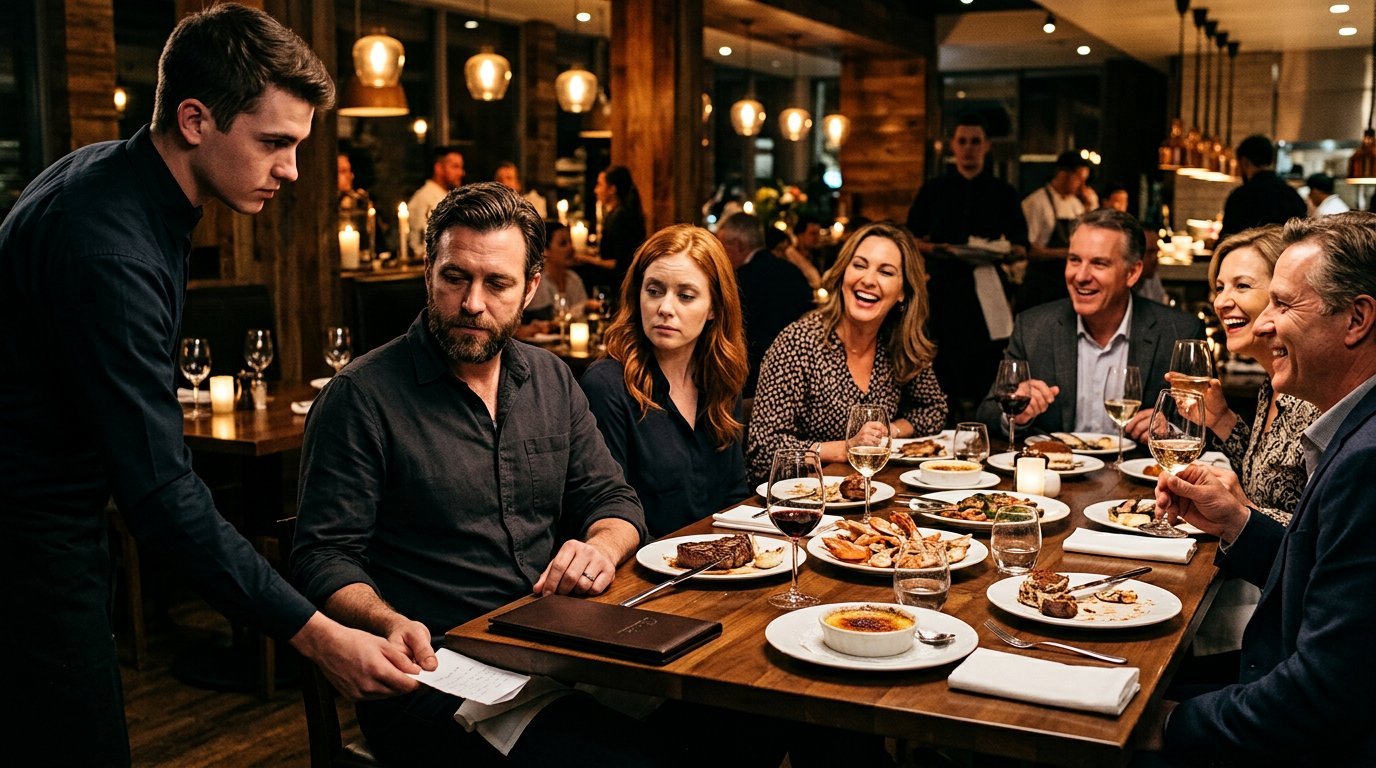
The staff pushed two tables together.
At first, I tried to enjoy myself. Serena had told me almost nothing about her family except that they were “complicated” and lived several hours away. I thought their surprise might explain her stiff shoulders and the way she kept folding her napkin into smaller and smaller squares.
Ron ordered a bottle of cabernet before I had opened the menu.
“Let’s get the good one,” he told the waiter, tapping the second-highest price on the list. “We’re celebrating.”
The waiter, whose name tag read Mateo, glanced at me. I should have spoken then. Instead, I smiled the weak smile of a man who had confused politeness with kindness.
Patricia ordered oysters for the table. Diane wanted lobster. Morris added a rib eye “for everyone to taste,” then ate most of it himself. Caleb ordered two appetizers because he could not decide. Every time I thought the parade had ended, someone remembered another side dish.
Serena barely touched her food.
I leaned toward her. “Did you know they were coming?”
“Not exactly.”
“What does that mean?”
Her eyes flicked toward Ron. “Can we talk later?”
Across the table, Patricia lifted her glass. “To Nathan. It’s wonderful when a man knows how to take care of people.”
Everyone drank except Serena and me.
That sentence settled heavily in my stomach.
I was not wealthy. I worked as a building inspector, drove a twelve-year-old car, and sent money each month to help my younger sister finish nursing school. Serena knew that. She also knew I had grown up in a house where my father paid every bill and used each one as evidence that the rest of us owed him silence.
I had promised myself I would never turn money into power. In trying to keep that promise, I sometimes let people turn my generosity into permission.
Dessert arrived without anyone asking whether I wanted it. Two chocolate tortes, crème brûlée, a cheese plate, and six small glasses of dessert wine crowded the table.
Mateo placed the leather check folder beside my elbow.
Ron leaned back, satisfied. “That was excellent.”
The others became fascinated by their phones.
I opened the folder.
Six hundred and twelve dollars, before tip.
Serena finally looked at me. “You can handle it, right?”
The room went quiet inside my head.
“No,” I said.
Her lips parted.
“I invited you to dinner,” I continued. “I did not invite five additional people, and I did not agree to buy two bottles of wine and half the menu.”
Ron chuckled. “Come on, son. Don’t embarrass her over a meal.”
“I’m not your son.”
Patricia’s expression hardened. “Serena said you were generous.”
“I am. But generous and easy to use are not the same thing.”
Serena’s face flushed. “Nathan, please. Just pay it, and I’ll explain later.”
I pushed the folder toward the center of the table. “We can split it six ways. I’ll cover my meal and Serena’s, because that is what I offered.”
Caleb muttered something under his breath. Morris signaled for Mateo with an impatient snap of his fingers.
Mateo came over carrying a water pitcher. As he leaned between us, his hand brushed the edge of my chair. A folded piece of receipt paper slid beneath my palm.
I waited until he stepped away before opening it under the table.
Four words were written in blue ink.
SHE’S NOT THEIR DAUGHTER.
Below that, in smaller letters:
DON’T GIVE THEM YOUR CARD. ASK FOR ME.
For a few seconds, I could hear only the clink of silverware from other tables.
I read the note again.
Serena watched me. The color had vanished from her face.
“What did he give you?” Ron asked.
“A receipt,” I said.
I folded the note and placed it in my pocket.
Then I did the first sensible thing I had done all evening. I stood.
“I need some air.”
Ron rose halfway. “We’re in the middle of settling this.”
“Then settle it.”
Mateo was waiting near the service station. Without looking at me, he carried a tray toward the back corridor. I followed and found him beside the kitchen doors with a woman in a dark blazer who introduced herself as the restaurant manager, Ms. Park.
Mateo spoke quickly. “I served four of those people three weeks ago. Same man, same older woman, same ‘brother.’ But the daughter was a blonde named Kelsey, and the father called himself Richard.”
Ms. Park held up a tablet displaying a security still. Ron, Patricia, Caleb, and Morris sat at another table with a different young woman and a bewildered older man.
“They ordered nearly eight hundred dollars’ worth of food,” she said. “The gentleman paid. The next day, he called because his credit card had been used at two electronics stores. We could not prove anyone here took the information, but we changed our payment procedure.”
My stomach dropped. “Are you saying Serena steals cards?”
“We don’t know her role,” Mateo said. “I heard the older man tell her near the restroom, ‘Keep him calm until we get the card.’ She looked frightened. I didn’t know whether she was part of it or trapped in it.”
I thought of Serena’s folded napkin, her untouched dinner, and the way she had said, Not exactly.
“Call the police,” I said.
Ms. Park nodded. “We already have.”
When I returned to the dining room, the table had changed. The warmth was gone. Ron held the check. Patricia was whispering fiercely to Serena. Caleb had put on his coat.
“We’re leaving,” Ron announced.
“The manager is dividing the bill,” I said. “And the police are on the way.”
Morris moved first. He headed toward the front door, but two members of staff were standing there. No one touched him. They simply did not move aside.
Ron turned on Serena. “What did you tell him?”
“Nothing,” she said.
He grabbed her wrist.
I stepped between them. “Let go.”
His grip tightened.
Serena looked at him, and something in her expression changed. Fear was still there, but beneath it was exhaustion—the kind that finally becomes heavier than obedience.
“I said let go,” she told him.
He released her just as two officers entered.
The next hour unfolded beneath lights that suddenly seemed too bright. The four people Serena had called family carried identification bearing four different surnames. Ron was actually Douglas Vane. Patricia was Lorna Beck. Caleb and Morris were not related to either of them.
Serena’s name, at least, was real.
She gave her statement in a corner booth while I sat near the window with a glass of water I never drank. From fragments of conversation, I learned that Douglas had met her outside a debt-relief office two months earlier. She was behind on rent after losing her job at a gallery. He offered cash for what he described as “social dining”—joining business dinners to make clients feel welcome.
The first dinner had ended with a stranger paying. The second involved photographing a credit card while its owner was distracted. By then, Douglas had copies of Serena’s driver’s license, her address, and messages that made her look like a willing accomplice.
“He said if I stopped, he’d tell the police it was all my idea,” she told the officer. “Tonight was supposed to be the last time.”
The last time. A phrase people use when they want tomorrow to absolve what they are doing today.
Douglas and two others were arrested on outstanding fraud warrants. Lorna was detained for questioning. Serena was not handcuffed, but the officer made clear that cooperation did not erase participation.
After midnight, we stood beneath the restaurant awning. Rain silvered the pavement. Serena hugged herself against the cold.
“I’m sorry,” she said.
I had imagined those words all evening. They did not bring relief.
“Were you ever going to tell me?”
“I kept thinking I could get through tonight, use my share to pay what I owed them, and disappear.”
“You asked me to pay.”
“I know.”
“You knew they might copy my card.”
Her eyes filled. “I was going to take it from the folder before they could. I thought I could protect you without—”
“Without telling me I was in danger?”
She looked down.
I wanted a simple answer. Victim or criminal. Girlfriend or stranger. But real people rarely stand cleanly on one side of a line. Serena had been manipulated. She had also brought the manipulation to my table.
“I care about you,” I said. “But I can’t be with you.”
She nodded as if the words had weight. “I understand.”
“I hope you tell the truth. All of it.”
“I will.”
Mateo came outside with my coat. I had left it over the chair.
“You okay?” he asked.
“No,” I said. Then, because honesty had become precious, I added, “But I think I will be.”
The case lasted eleven months. Douglas’s group had used dating apps and fake family dinners in four cities. Sometimes they wanted only an expensive meal. Other times, while one person created an argument over the check, another photographed cards, identification, or banking apps left open on phones.
Serena pleaded guilty to a lesser fraud charge, repaid what she could, and received probation in exchange for testimony. She sent me one letter through her attorney. I left it unopened for a week.
When I finally read it, there were no excuses.
She wrote about shame and how it makes the next bad decision look like the only door left in a burning room. She said I had been kind to her and she had mistaken kindness for a resource she could spend. She did not ask me to forgive her or contact her.
I wrote back once.
I told her I hoped she built a life that did not require pretending. I told her forgiveness was something I was working toward for my own peace, not a bridge back to our relationship.
Then I let her go.
Mateo and I became friends in the accidental way adults often do—through one invitation that becomes a habit. He refused the cash reward the credit-card company offered, so I took him to a baseball game. He brought his younger brother. I brought my sister, Ava, home from nursing school for the weekend.
The four of us argued about terrible stadium food and cheered for a team that lost by six runs. It was the most relaxed I had felt in months.
A year after the dinner, Bellweather invited everyone involved in the case to a small event celebrating new fraud-prevention training for local restaurants. Ms. Park had created a discreet code guests could use if they felt pressured over a bill or unsafe with their companions. Mateo taught servers to notice not just theft, but silence—the person at a crowded table whose voice had disappeared.
I stood near the window where I had once waited for Serena. The restaurant looked smaller than I remembered.
Ava joined me holding two slices of cake. “You’re doing the brooding-window thing.”
“I’m reflecting.”
“You’re fogging up the glass.”
She handed me a plate.
Across the room, Mateo’s mother was insisting that Ms. Park take a container of homemade pastries. His brother was stacking chairs. Staff members laughed around a table where no one was performing intimacy and no one was waiting for a stranger to pay.
I thought about the note.
She’s not their daughter.
At first, I believed those words had saved me from a six-hundred-dollar bill. Later, I understood they had saved me from something more expensive: the belief that keeping peace was always the same as being kind.
Kindness can pay for dinner. It can offer patience, shelter, or another chance. But kindness without boundaries is only an unlocked door, and not everyone who enters comes as a guest.
I still like taking people to dinner. I still reach for the check more often than I should. The difference is that now I make the offer clearly, and I listen when discomfort speaks.
That evening at Bellweather, seven of us crowded around a table meant for six. When the bill arrived, Mateo placed it in the center.
“Separate checks?” he asked with exaggerated seriousness.
“Absolutely,” I said.
Everyone laughed.
Then Ava stole one of my fries, Ms. Park poured the last of the coffee, and the check passed from hand to willing hand.
No one expected one person to carry it.
That, I had learned, was what family looked like.
◆