My mother was always too busy running from one man to another to notice whether I had eaten dinner, finished my homework, or even come home. My older sister, Vanessa, learned early that attention was a kind of currency, and she spent hers only where it might earn something back. To her, I was the quiet boy in the spare room, someone whose birthday could be forgotten without consequence. But Grandma Rose remembered everything. She remembered that I hated the crusts on sandwiches, that thunder made me nervous, and that I wanted to be a veterinarian before I even knew how to spell the word. When no one else cared, she raised me. She was my safe place, my loudest supporter, and the only person who never made love feel like a prize I had to win.
Grandma lived in a narrow white house with green shutters and a garden that refused to obey fences. Mint grew through the porch steps, tomatoes leaned into the driveway, and sunflowers nodded over the neighbor’s wall. Every afternoon, she sat at the kitchen table with a cup of tea and asked me to tell her one good thing and one hard thing about my day. She never interrupted. Even when I had nothing more serious to report than a failed spelling test, she listened as if I were explaining the condition of the world.
When I was eleven, she saved for months to take me to the city zoo. We could afford only one souvenir photograph, taken beside a painted wooden elephant near the entrance. In it, Grandma wore a ridiculous straw hat, and I had chocolate ice cream on my chin. Her arm circled my shoulders. We looked neither elegant nor wealthy, but we looked happy. She framed that picture and hung it in her hallway, where I passed it every morning on my way to school.
Years later, when she became ill, I drove her to appointments, filled her pill organizer, and cooked the soups she had once made for me. She apologized every time I helped her stand. I always gave the same answer: “You carried me long enough. It’s my turn.” Still, I was unprepared for the morning the hospital called. Grief did not arrive like a dramatic storm. It entered quietly and removed the weight from ordinary things. Her teacup became unbearable. Her garden gloves seemed sacred. The white house, without her inside it, looked like a sentence with its meaning erased.
The reading of her will took place eight days after the funeral. My mother arrived late in dark glasses. Vanessa arrived early and spent twenty minutes estimating what the house might sell for. I sat across from them in the lawyer’s office, holding my hands together so tightly that my knuckles hurt.
Grandma left the house to my mother. She left her car to Vanessa. There were small gifts for neighbors and a donation to the animal shelter. Then the lawyer looked at me with an expression I could not read.
“To my grandson, Thomas,” he said, “I leave the framed photograph of us at the zoo, together with the enclosed note.”
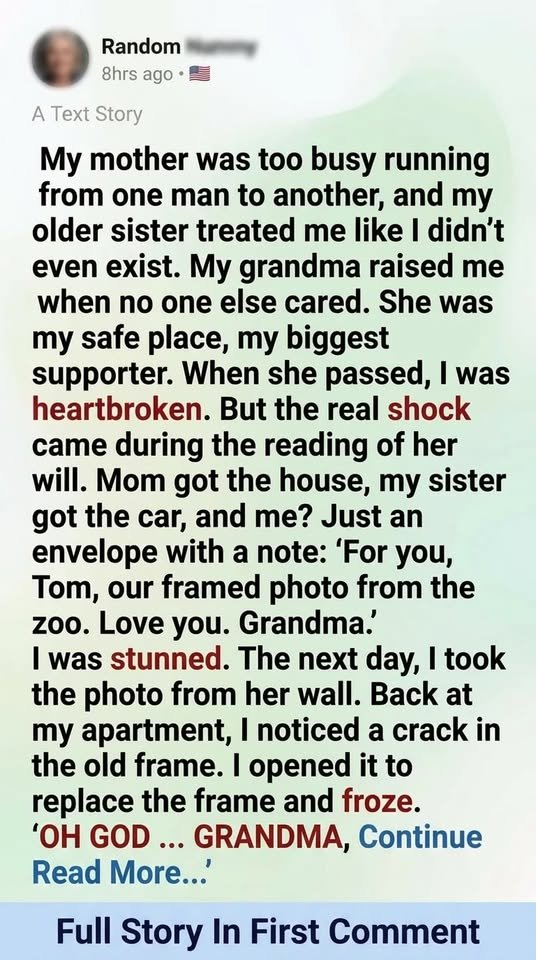
He handed me a plain envelope. Inside, in Grandma’s careful blue handwriting, were the words: “For you, Tom, our framed photo from the zoo. Love you. Grandma.”
Vanessa made a sound that might have been a laugh. My mother avoided my eyes. I told myself the photograph mattered more than any car, and in one sense it did. Yet hurt rose in me anyway. Grandma knew how insecure I felt about my place in the family. Why had she made her final gesture look like proof that I had imagined our closeness? I hated myself for thinking about money while mourning her, but grief and disappointment can occupy the same heart.
The next day, I took the photograph from her hallway. Back at my apartment, I noticed a crack running through the old wooden frame. Afraid the glass might damage the picture, I turned it over and pried loose the rusted tabs. The backing came away. A small brass key dropped onto the table.
I froze.
Taped behind the photograph was a second envelope, thicker than the first. Across the front she had written, “For Tom alone. Read this before you speak to anyone.” My hands shook so badly that I tore one corner opening it.
My dear boy, if you found this, you noticed what everyone else overlooked. That has always been your gift. The key is for box 417 at First County Bank. Take this letter to Mr. Alden, the manager. Do not feel guilty. What is waiting there is not payment for loving me. Love cannot be bought. It is simply a door, and I hope you will use it to open another.
I sat there for a long time, hearing her voice inside every line. Then I laughed and cried at once, startling the cat in the next apartment.
◆ ◆ ◆
Mr. Alden was expecting me. Inside safe-deposit box 417 lay a leather folder, a sealed document, several savings certificates, and a stack of letters tied with green ribbon. The document established a trust in my name. Grandma had quietly saved and invested for more than thirty years. The amount was not the impossible fortune that appears in fairy tales, but it was enough to erase my student loans, pay for veterinary school, and leave a substantial reserve.
There was also a deed to six acres outside town. I recognized the land immediately. It included an abandoned farmhouse and a red barn we used to pass on Sunday drives. I had once told Grandma that, if I ever had enough money, I would turn it into a rescue center where old dogs, injured wildlife, and unwanted farm animals could be cared for instead of discarded.
The final letter explained everything. Years earlier, Grandma had transferred most of her savings into the trust and bought the land through an attorney. The house she left to my mother still carried a home-equity loan. The car given to Vanessa was fully paid for but already twelve years old. Grandma was not punishing them. She had given each woman exactly what she believed she could manage—and had protected my inheritance from becoming the center of a family fight.
Your mother and sister look at labels, Tom. They will see “house,” “car,” and “old photograph” and decide immediately what each is worth. You look closer. You always have. Please do not use what I leave you to prove that they were wrong about you. Build something that proves you were right to remain kind.
I wanted to keep the secret, but secrets have shadows. My mother called that evening to ask whether I could help clean the house before she listed it. Vanessa wanted the antique dresser. Neither asked about the photograph. For three weeks, I said nothing. I met with the trustee, examined the land, and spoke with the veterinary college about returning to finish the degree I had postponed while caring for Grandma.
Then Vanessa saw me leaving the bank with Mr. Alden. By dinner, she had constructed a conspiracy. She accused me of manipulating a dying woman. My mother demanded to know what Grandma had “hidden.” Their anger was so familiar that for a moment I became a child again, standing unheard in a noisy room.
But Grandma had prepared me even for that. I placed a photocopy of her final letter on the table.
“She didn’t leave me a pile of cash to spend,” I said. “She created a trust for my education and an animal rescue. The trustee controls the money. I cannot give it away, and you cannot take it.”
Vanessa read only halfway before pushing the pages aside. My mother finished every line. When she reached the part about kindness, her face changed. She stared toward the hallway where the photograph had hung.
“She thought I would sell the house,” she whispered.
“You told her you would.”
“I thought she didn’t listen.”
“She always listened.”
My mother began to cry—not prettily, not persuasively, but with the exhausted grief of someone finally seeing the total of her choices. I did not forgive her in that instant. Real forgiveness is not a door flung open; it is a road, and sometimes the person who caused the distance must walk most of it. Still, I sat beside her. Grandma had asked me to remain kind, not foolish, and I was beginning to understand the difference.
◆ ◆ ◆
Two years later, the red barn reopened as Rose’s Haven. We had kennels warmed for winter, a small treatment room, fenced pasture, and a rehabilitation enclosure for wild animals. Over the office door hung the restored zoo photograph. I kept the crack in the original frame, sealed beneath clear resin, because some damage belongs to the history of a thing rather than its destruction.
I finished veterinary school the following spring. At the opening ceremony, Mr. Alden stood beside Grandma’s old neighbors. My mother came too. She had sold the white house, paid the loan, and moved into a modest apartment. For nearly a year, she had been showing up every Saturday to wash blankets and clean feeding bowls. She never asked me for money. Instead, she asked careful questions about my life and tried to listen to the answers. We were not magically healed, but we were building something honest.
Vanessa stayed away until a cold November afternoon, when she appeared carrying a cardboard box. Inside was a trembling, mud-covered puppy she had found beside the highway.
“I didn’t know where else to take him,” she said.
I could have reminded her of the lawyer’s office and the laugh she had tried to hide. I could have made her feel small. Instead, I took the puppy, wrapped him in a towel, and asked her to hold the flashlight while I examined his injured leg.
She returned the next day to ask whether he had survived. Then she returned the day after that. Eventually, she adopted him.
On the fifth anniversary of Grandma’s death, I visited the zoo. I wore no straw hat, and I skipped the chocolate ice cream, but I stood beside the same painted elephant. A staff member took my picture while I held a new sign for Rose’s Haven, announcing our partnership with the zoo’s wildlife rehabilitation program.
That evening, I placed the new picture behind the old one. Before closing the frame, I added a letter of my own.
Dear Grandma, I found the door. You were right: what waited behind it was not money. It was a future. The barn is full, the garden is growing, Mom is trying, and Vanessa finally learned to look twice. I still miss you every day. One good thing: we saved a fox this morning. One hard thing: I wanted to call you afterward. Love, Tom.
I secured the backing and hung the frame above my desk. Visitors saw only an elderly woman in a silly hat with her arm around a boy who had ice cream on his face. They could not see the key that had fallen out, the letters, the land, or the years of hope hidden behind that ordinary image.
But that was Grandma’s final lesson: the most valuable inheritance is rarely the thing everyone can see. Sometimes it is a person who listens. Sometimes it is the courage to look closer. And sometimes it is love, placed quietly behind an old photograph, waiting until you are ready to discover what it has been preparing you to become.