My husband disappeared in 2016, when our eight-year-old son was still waiting for him to come home from work. That morning he kissed our boy goodbye at the front door — he had a habit of ruffling Sam’s hair and saying, “Be good, buddy. Daddy’ll be home for dinner” — and then he walked out into an ordinary Tuesday and vanished without a trace. No phone call. No note. No bank activity. Nothing.
I know how that sounds. People imagine a man who disappears must have wanted to go — that he had a secret, a second life, a reason. But you did not know my husband. He was not a man with secrets. He was a man who fixed the porch light the same week it broke and called his mother every Sunday and kept a photo of Sam in the visor of his car. The morning he vanished, he had stopped at the gas station and bought milk. We know this because his car was found there, door open, engine running, keys in the ignition, a gallon of milk on the passenger seat. And no trace of him, ever again.
I was thirty-four, raising our son alone while my sixty-eight-year-old mother-in-law blamed me every single day. That is not an exaggeration. She called me worthless. She insisted I had driven her son away, that a good wife would have known something was wrong, that if I had been the woman he deserved he would never have left. And she made sure the whole town believed it. I would stand in the checkout line and feel the eyes on me. The women from her church would cross the street. Sam’s classmates were told by their parents that my son’s father had run away, and children are not gentle with that kind of information. For nine years, I carried it all. Two jobs. Barely thirty-nine thousand dollars a year. A little boy asking me at every birthday why Daddy didn’t call.
I want to tell you that I stayed strong the whole time. The truth is smaller and quieter. There were nights I sat on the kitchen floor after Sam went to bed and let myself cry, because that was the only place I could afford to fall apart. There were years I went to bed at midnight and woke at five, and the exhaustion felt like a second person living in my body. But I got up every single day, because there was a boy who needed breakfast and homework help and someone to clap at his school plays. And every year, on the anniversary of the disappearance, I stood at the gas station where they found his car and I waited, just in case.
Then, in 2025, my mother-in-law passed away. She was old, and her heart, which had never had much room for me, finally gave out. I did not hate her. That is the strange part. Nine years of her cruelty, and by the end I mostly pitied her, because I understood something she never did: she had lost her son, and grief had curdled in her into blame, because it was easier to blame me than to sit with the unbearable truth that sometimes people just vanish.
I planned the funeral. That is the kind of woman I am — the one who, after everything, still does what needs to be done. Sam was seventeen by then, taller than me, with his father’s eyes. He stood beside me at the church door and squeezed my hand, and I remember thinking, at least this part is over. At least after today, the town could finally stop looking at me like the woman who made a good man disappear.
The service began. The organ played. The minister cleared his throat. And then, just as the opening prayer was beginning, the church doors slowly opened.
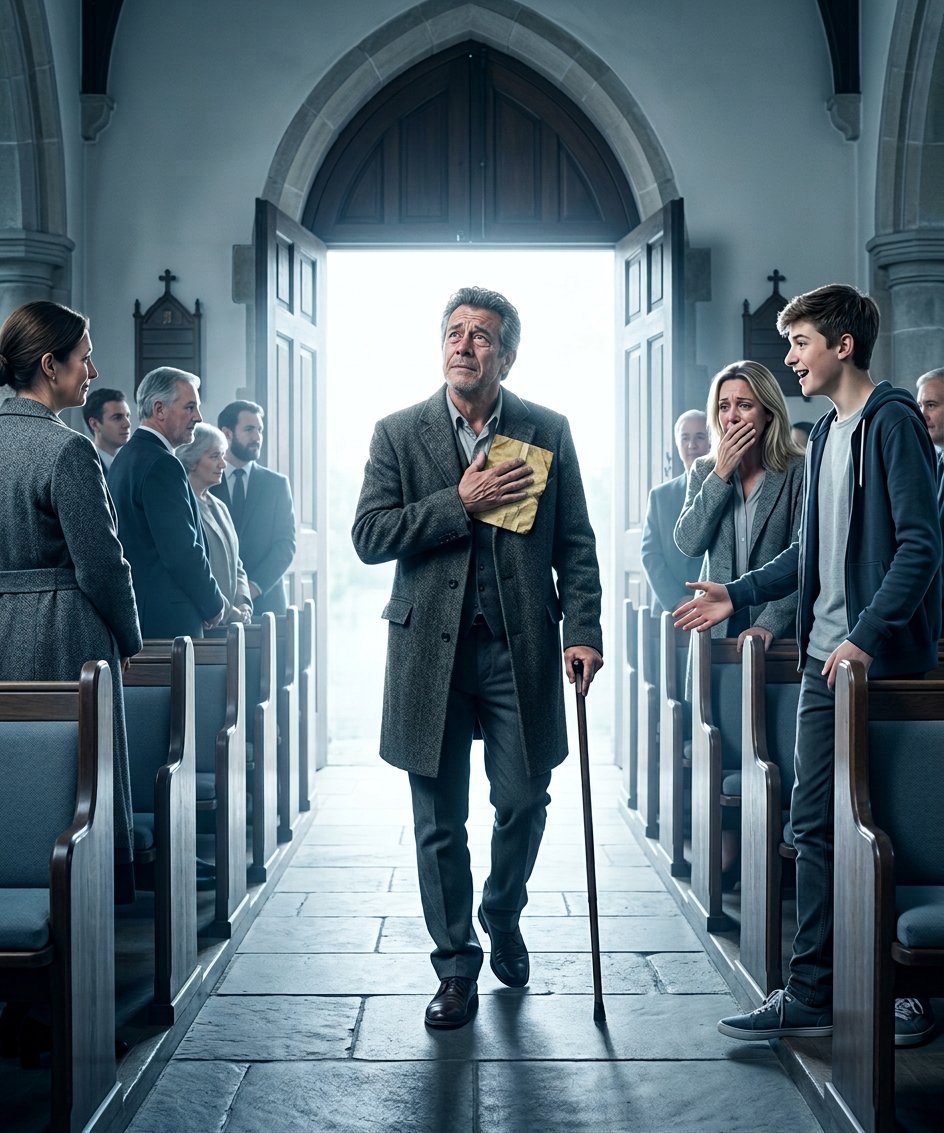
Every head turned. It is not a figure of speech. The whole congregation turned in their pews, the way a field of wheat turns in the wind, and the light from the open doors poured down the center aisle. And walking down that aisle was my husband. Alive. Older. The man I had mourned for nearly a decade. He walked with a cane, with a slight drag in his left leg, and his hair was gray at the temples, but it was him. It was David. The boy I had fallen in love with at nineteen. The man who had kissed our son goodbye and never come home.
Walking down the aisle was my husband… alive, older, and the man I’d mourned for nearly a decade.
For a moment I thought I was dreaming. That the grief had finally broken something in me and I was seeing what I wanted to see. Then he looked straight at me, and there were tears filling his eyes, and I noticed one shocking detail that changed everything I thought I knew about the day he disappeared.
Pinned inside his open coat, over his heart, was a creased, yellowed piece of paper. It took me a long moment to recognize it. It was the missing-person flyer. The one Sam and I had made at the kitchen table nine years ago, with his photograph on it and the words “HAVE YOU SEEN THIS MAN?” across the top. It was soft and worn at the edges, the way paper gets when it has been folded and unfolded a thousand times. And beneath it, his left hand — the hand that wasn’t holding the cane — was curled against his chest, the fingers stiff, and I could see a long, faded scar running from his temple down into his hairline.
He stopped a few feet from me. The church was so quiet I could hear my own heartbeat. And then he said my name — my name, in a voice I had replayed in my head for nine years — and the whole story came out, in pieces, the way water comes through a cracking dam.
The morning he disappeared, he had been hit by a car. A hit-and-run, in the parking lot of a strip mall two streets from the gas station where he’d stopped for milk. The driver never stopped. He was found by a passerby with no wallet, no identification — his wallet had been in the car, which was found at the gas station a block away, which is why the trail went cold. He had been in a coma for weeks, and when he finally woke, in a hospital a hundred miles from home, he did not know his own name. Amnesia, the doctors said. The kind that takes everything. He could not remember me. He could not remember Sam. He could not remember the house with the porch light he always fixed.
For nine years he had lived in a small town under a name he did not choose, working odd jobs, always feeling, he said, like a man standing in a room with the lights off, reaching for something he could not find. He kept the missing-person flyer, he told me, because the face on it — the boy — stirred something in him he could not explain. He had no memory of the man in the photo, but the boy’s face made his chest ache, and he could not throw the paper away. He folded it and carried it over his heart, not understanding why.
And then, two weeks ago, he saw his mother’s death notice in an online newspaper — his mother, whose face he suddenly, inexplicably, remembered — and everything came rushing back. His name. His wife. His son. The Tuesday morning. The kiss on Sam’s head. All of it, in a flood so violent it dropped him to his knees in the middle of a gas station convenience store, nine years and a hundred miles from home.
He came to the funeral for his mother, and for us.
I want to tell you that I ran to him, that the church dissolved into applause, that Sam threw his arms around his father’s neck. The truth is that I stood very still, because for nine years I had built a wall against exactly this moment, and walls do not fall all at once. Sam was the one who moved first. He stepped forward — my son, who had been eight the last time he saw his father — and he looked at the man in the aisle, at the flyer pinned over his heart, at the cane and the scar and the tears, and he said, in a voice like a bell, “Dad?”
And David said, “Be good, buddy. Daddy’s home for dinner.”
That was when the wall came down. That was when I crossed the aisle and put my arms around the man I had mourned for nearly a decade, and felt him breathing, and let myself believe it.
The part nobody tells you about a miracle is that it is not an ending. It is a beginning, and the beginning is hard. Nine years is a long time. A boy grows up. A wife learns to survive alone. A man comes home to a family that has learned, painfully, to live without him, and he must learn them all over again, and they must learn him — the man with the cane and the scar and the missing years. There are hard days. There are moments when Sam, seventeen and proud, does not know how to have a father again. There are nights when David wakes up gasping, afraid he has forgotten us again. Healing is slow, and it does not move in a straight line.
But we are doing it. We are rebuilding, the three of us, one ordinary Tuesday at a time. Last month, David fixed the porch light. The same porch light. He stood on the step with his cane propped against the railing, and Sam held the ladder, and I watched them from the kitchen window and cried the whole time, because that porch light had been broken in me for nine years, and he fixed it.
My mother-in-law went to her grave believing her son had run away, and that I had driven him off. I will never get to tell her the truth, and I have made peace with that, because the truth was never really for her. It was for me. And the truth is this: I did not drive my husband away. I never stopped loving him, and he never stopped being mine, and for nine years he carried a paper with his own face on it over his heart, because even a man who has forgotten everything can still feel the shape of the people he loves.
Some people never come back. I know that. I spent nine years learning to live with it. But sometimes, if you are very lucky, and you do not give up, the church doors open, and the man you mourned walks down the aisle, and the story you thought was over turns out to have only just begun.