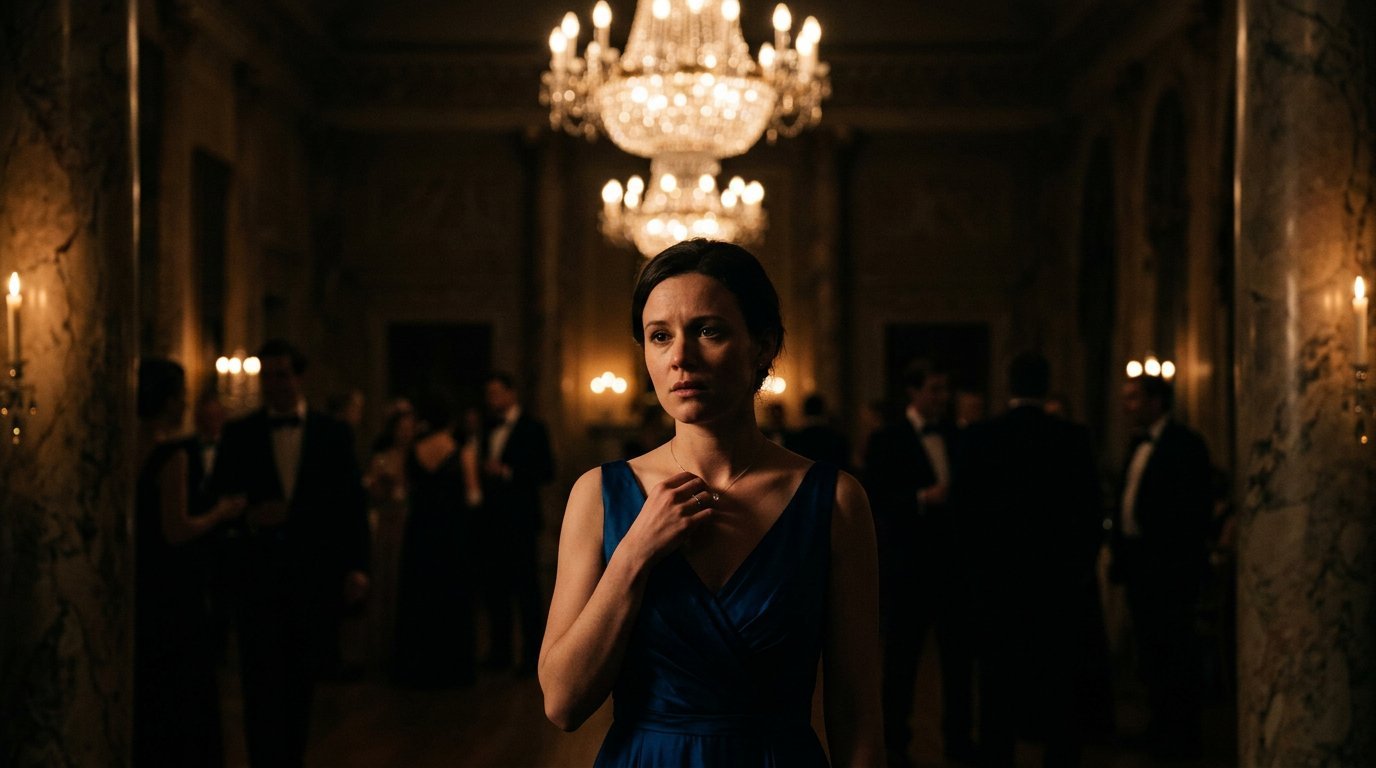
The invitation said black tie. I had spent a week on that dress — the blue one, the only one I owned that came close to formal — bought secondhand and hemmed by hand at the kitchen table while Daniel watched the news. I thought I looked elegant. I thought, for once, that I could stand beside him and not feel like the borrowed thing in the room. But before we even reached the ballroom doors, my husband took my arm, pulled me into the shadow of a marble pillar, and leaned down to whisper the words that would end us.
“Don’t tell anyone you’re my wife,” he said. “If anyone asks, say you work here. Stay in the back.”
I remember the way the words landed, one after another, like small stones dropped into still water. Stay in the back. Then his eyes drifted down to my neck, to the little silver necklace my late foster mother had left me — the only thing of hers I had ever owned — and he laughed, loud enough for the people passing us to hear. “And for God’s sake, take off that flea-market junk before anyone sees it.”
His colleagues were arriving in a stream of black cars, and he said it in front of them, with the easy cruelty of a man who knew I would not make a scene. Six years of marriage, and in that single moment I finally understood something I had spent all six years refusing to see. My husband was not ambitious. He was not stressed. He was not “just tired.” My husband was ashamed of me.
How long do you keep loving someone who hides you? That was the question turning in my chest as I followed him through the doors, one step behind, the way I had always followed him. How long do you let yourself be the secret? I had given him six years of my life. I had moved across the country for his career. I had learned to smile at dinner parties where the other wives discussed their children’s schools and their vacations and then fell silent when I opened my mouth. I had become a background in my own life. And still, somehow, it had not been enough. It is a strange thing, to realize the person you chose will never choose you back. It does not break you all at once. It leaks out of you, slowly, like air from a tire, until one night you look down and realize you have been flat for years.
Then the ballroom went quiet.
It happened the way silence happens in those rooms — the music did not stop, but the conversation did, a ripple moving outward from the doors as the whole gala turned to look. The billionaire chairman of my husband’s company had walked in. Marcus Ashford. The man every executive in that room spent their entire career trying to impress, the name Daniel practiced saying in the mirror. He was old, silver-haired, leaning on a cane, and on his arm was his sister, a sharp-eyed woman in emerald silk who looked at the crowd the way a lighthouse looks at a dark sea.
They made their slow circuit of the room, and everyone in their path straightened and smiled and angled for a word. Daniel had already begun to position himself. And then, all at once, the sister stopped walking. She went still in a way that made the people around her go still too. And she was staring at me. No — at my throat. At the little silver necklace that was, according to my husband, flea-market junk.
She crossed the room toward me, and I felt Daniel stiffen beside me, already calculating what to say. “Where did you get that?” she asked, and her voice was soft, softer than I expected, but her eyes never left the pendant.
“My mother gave it to me,” I said, because that was the simplest truth.
Daniel laughed, the polite, dismissive laugh he used to correct me in front of people who mattered. “Her foster mother,” he said, as if that made it smaller. “It’s just an old piece.”
But the old man had come to stand beside his sister, and he asked, in a voice that carried across the suddenly silent ballroom, to see the back of the pendant. I lifted the chain over my head and handed it to him. His hands were shaking as he turned it over, and there, in the light of a thousand crystal chandeliers, he read the two engraved letters on the back.
And the entire room heard what he said next.
The chairman of the Ashford family had never stopped searching for the child who wore that necklace. Thirty-one years. Thirty-one years of private investigators and empty leads and a family that never gave up. And the woman my husband had just told to hide in the back of the room — the woman he called an embarrassment, the woman he had never once introduced as his wife — was their missing heir.
“Thirty-one years,” he whispered, “and I have been looking for you in every corner of the world. And you were standing in my ballroom all along.”
I want to tell you that I remember everything clearly after that. The truth is that I remember very little, and I remember all of it, in the strange way you remember a car accident — in flashes, in sounds, in the feeling of the floor shifting under you. The sister’s hand closing over mine. Daniel’s face going the color of the table linens. A lawyer appearing at the chairman’s side with a folder I did not ask to see. The words “DNA test” and “no question” and “we always knew.”
They told me the story in the days that followed, in pieces, the way you would feed a starving person so as not to overwhelm them. The Ashfords’ youngest son and his wife had died in a plane crash when I was barely a year old, but not before sending their baby — me — away for the weekend with a nanny. The nanny never came back. The wreckage was found, the child was not, and for thirty-one years the family believed I had been taken, or lost, or dead, and they searched anyway. They searched, because that is what you do when someone is missing and you have money and you refuse to let go.
The nanny, it turned out, had not stolen me. She had been afraid. Afraid of the press, afraid of the men the family hired, afraid of something she never fully explained. So she changed my name and raised me in a small apartment with thin walls, and she loved me, and when she died she left me the necklace she had kept hidden all those years — the necklace with my father’s initials on the back, the one thing that connected me to a family I did not know existed.
My foster mother. Daniel said the words like they were a demotion. He did not know, and he did not care to know, that the woman who raised me had held me through fevers and walked me to school in the rain and gone without dinner so I could have seconds. He had never asked about her. In six years, he had never once asked.
The DNA test came back in nine days. It was, the lawyer said, a formality. The engraved letters, the photographs, the dates, the hospital records from before the crash — they all matched. I was Isla Ashford. I had always been Isla Ashford. I had simply been lost, and then I had been hidden, and then I had married a man who wanted to keep me hidden forever.
Daniel came to me before the divorce papers were signed, which I suppose tells you everything you need to know about him. He did not apologize. He proposed. He got down on one knee in the hallway of the hotel where the family had put me up, and he said that this changed everything, that he had always loved me, that now we could finally be the couple we were meant to be. The couple we were meant to be. As if six years of being told to stand in the back could be erased by a bank balance. I looked at him, this man I had once loved with my whole foolish heart, and I felt nothing. That was the part that surprised me. Not anger. Nothing.
“You didn’t want a wife,” I told him. “You wanted someone to stand in the back. And I’m done standing in the back, Daniel.”
The divorce was quiet, in the way things done by very expensive lawyers are quiet. He contested nothing, because there was nothing to contest and everyone involved knew it. I kept my name — the one my mother gave me, the one I had grown up with, the one that was mine before any of this. Some doors, once closed, you do not open again, not even to look.
The part nobody tells you about coming into money and family all at once is that it is not the happy ending it looks like from the outside. It is disorienting. It is grief and joy braided together so tightly you cannot tell where one ends and the other begins. I mourned the mother who raised me all over again, and I met a grandmother I did not know, and an uncle who cried when he shook my hand, and cousins who wanted to know my favorite foods. I learned the shape of a family that had been waiting for me longer than I had been alive. And slowly, very slowly, I stopped being afraid of being seen.
I still wear the necklace. I wear it to galas now, with the chain polished and the little silver pendant resting against my heart, and when people ask where I got it, I say the truest thing I know how to say. My mother gave it to me. Both of them, in their way.
The woman who raised me gave me her love and her courage and a small silver chain I almost let a cruel man convince me was worthless. The family who searched for me for thirty-one years gave me back my name. And the man who told me to hide in the back gave me, without ever meaning to, the one gift I did not know I needed. He showed me exactly what I was worth to him.
And that, in the end, was worth more than all of it.