Thirteen years after my divorce, I unexpectedly found myself standing in the same auditorium as my ex-husband and the son he had raised with the woman he chose instead of me.
The moment Julian recognized me, his face hardened.
“How dare you come here?”
I didn’t answer.
I didn’t need to.
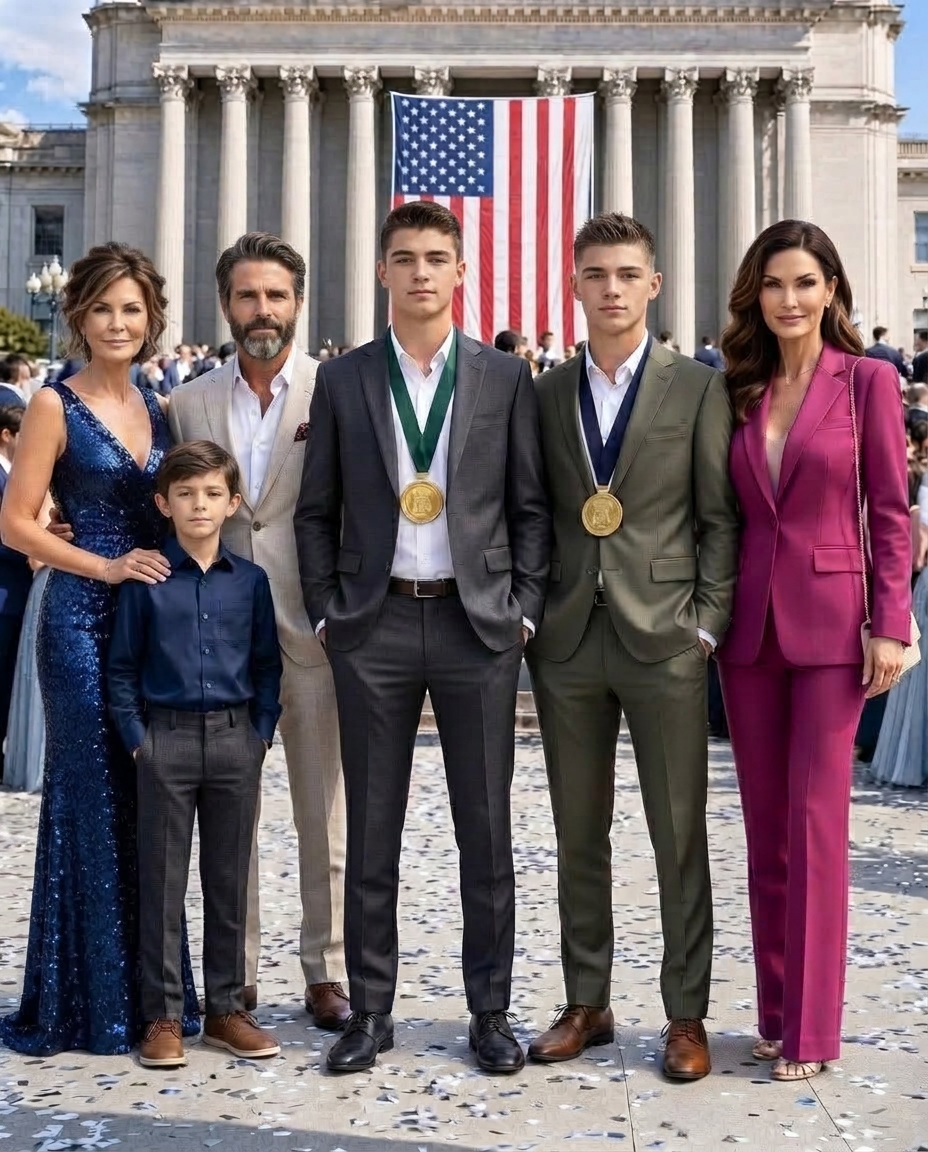
Because a few minutes later, my twin sons walked onto the stage to receive the highest honor of the entire competition.
And both Julian and his wife went completely pale.
“And now,” the host announced excitedly, “the Grand Prize goes to the contestants who earned the first perfect score in the history of this tournament. Congratulations to the twin brothers… Leo Holloway and Ethan Holloway!”
The auditorium exploded with applause.
But I barely heard any of it.
My eyes were fixed on my sons as they stood and made their way toward the stage.
The enormous screens above the auditorium instantly displayed their faces.
Across the room, Julian froze.
Thirteen years had passed since he walked away from me while I was pregnant.
But there was no possible way he could miss the resemblance.
Leo and Ethan had his sharp jaw.
His straight nose.
The same serious expression Julian had worn in old photographs from his teenage years.
But their eyes were mine.
Dark.
Steady.
Unshaken.
“Holloway,” the host repeated.
My maiden name.
Beside Julian, Victoria suddenly jumped to her feet.
She was the wealthy woman he had left me for all those years ago.
“What is happening?” she demanded. “There has to be some mistake! Where is Preston?”
At that exact moment, the final rankings appeared across the giant screen.
Near the very bottom was one familiar name.
Preston.
Victoria’s son.
The boy Julian had spent years surrounding with elite tutors, private schools, expensive coaching, and every advantage money could provide.
He had finished last.
Victoria’s face turned bright red.
“This is ridiculous!”
She slammed her hands against the velvet railing.
“I paid for the best preparation available! How does my son lose to two fatherless nobodies?”
Her words carried farther than she intended.
Fatherless nobodies.
I slowly looked toward Julian.
His face had gone gray.
Because he knew exactly who those boys were.
Those “fatherless” teenagers were his sons.
The same sons he had abandoned before they were even born.
Victoria grabbed the front of his expensive suit.
“Julian, do something! You’re the main sponsor of this event. Demand another review. Have those boys disqualified!”
But Julian barely seemed to hear her.
He wasn’t looking at Victoria.
He was staring at the stage.
At Leo.
At Ethan.
At the two lives he had chosen to walk away from thirteen years earlier.
And suddenly, everything he had spent those years chasing seemed strangely insignificant.
Victoria shook his arm.
“Are you even listening to me?”
Julian finally turned.
Something in his expression had changed.
He removed her hand from his jacket.
“Enough, Victoria.”
She stared at him.
“What?”
“I said enough.”
His voice was cold.
“Do not say another word about those boys.”
For the first time, Victoria seemed genuinely stunned.
Julian stood.
His perfectly tailored designer suit, once a symbol of the successful life he had chosen, suddenly looked uncomfortable on him.
Then he stepped into the aisle.
And started walking toward the stage.
Toward me.
Toward the twin sons he had never bothered to meet.
Toward the consequences of a decision he had made thirteen years earlier.
What Julian didn’t know was that his presence at the competition wasn’t a surprise to me.
I had known he would be there.
And Leo and Ethan receiving those gold medals was only the beginning.
Because Julian thought he was walking toward an uncomfortable family reunion.
He had no idea he was walking straight into something I had been preparing for thirteen years.
PART 2
Julian stopped three feet from me.
The applause was still rolling through the auditorium, but the space between us felt silent.
“Those boys,” he said. “They’re mine.”
It was not a question.
Before I could answer, Leo and Ethan came down from the stage wearing their gold medals. Leo held the trophy. Ethan carried the scholarship certificate they had won for designing an inexpensive water-contamination sensor for rural schools.
They saw Julian and knew him immediately.
The competition had begun with more than four hundred teams. Leo built the sensor housing from discarded laboratory parts, while Ethan wrote the calibration program and tested samples with their science teacher. They had lost regional events, rebuilt the device twice, and paid their entry fee with money earned tutoring younger students. No sponsor had placed them on that stage.
I had never lied to my sons. I had shown them one photograph and told them the truth in language they could understand at every age: their father left before they were born, and his choice had never been a measure of their worth.
Leo met Julian’s stare. “We know who you are.”
Julian looked wounded, as though he were the one discovering that thirteen years had been taken from him.
“I didn’t know there were two of you.”
“You knew I was carrying twins,” I said.
I opened my handbag and removed a blue envelope. Inside were copies of the messages Julian sent after my final ultrasound, a returned letter announcing the boys’ birth, and a check Victoria had offered me on the condition that I never identify Julian as their father.
I had kept everything.
The final page was new: notice of a paternity action and a court-authorized DNA appointment scheduled for the following morning.
Julian stared at it. “You planned this.”
“I prepared for the day my sons asked for the truth to have a legal name.”
The boys had requested the filing after completing applications for high school scholarships. Several forms asked for family medical history. They were tired of writing unknown beside questions I could answer but had never been allowed to prove.
Victoria pushed through the crowd.
“This is extortion,” she snapped. “She waited until the boys won, and now she wants money.”
Ethan flinched. Leo moved closer to him.
I stepped between her and my sons. “You will not speak to them again.”
The tournament director arrived before Victoria could answer. She carried a formal complaint alleging that Leo and Ethan had stolen code used in their water sensor.
The complaint had been submitted anonymously at 2:04 p.m., two hours before the final results. Its attached file came from an account registered to the Mercer Educational Foundation—the organization Julian controlled and the tournament’s principal sponsor.
Julian read the header and went pale again.
“I didn’t file this.”
Victoria glanced toward Preston.
Their son sat alone near the velvet railing, staring at the floor.
The director explained that the judges had reviewed the accusation before announcing the prize. The twins’ development logs proved their work was original. Their perfect score stood.
But someone connected to Julian’s foundation had tried to disqualify them before Julian publicly recognized their faces.
Only Victoria had known their names in advance.
PART 3
Victoria denied filing the complaint.
She claimed an employee must have acted without permission, but the tournament director preserved the account records for investigation. The message originated from the sponsor lounge, where Victoria had spent most of the afternoon.
Julian asked to speak with me privately.
I refused to leave the boys, so he followed us into a conference room with my sister and the tournament’s family liaison present.
“I made mistakes,” he began.
Ethan looked at him. “Was leaving a mistake, or was it what you wanted?”
Julian had no prepared answer for a thirteen-year-old who spoke without anger.
He said Victoria convinced him I would use the pregnancy to trap him. He said he was twenty-eight, frightened, and overwhelmed by responsibility. Then he spoke about regret as if regret had packed lunches, sat beside hospital beds, and worked late to pay for science camp.
“You had thirteen years to be less frightened,” Leo said.
Julian offered to pay for school, college, and anything else the boys needed. His attorney could create trusts immediately.
“What do you want us to sign?” I asked.
He looked down.
The offer required confidentiality. No public paternity acknowledgment. No statements connecting the twins to the competition’s main sponsor. He wanted to purchase responsibility without accepting it.
I placed the papers back in his hands.
Victoria waited outside the conference room. She warned that Julian’s lawyers could keep the case alive until the boys finished college. Then she repeated the bargain she had offered during my pregnancy: take money, use my maiden name, and disappear quietly.
“You still think silence is dignity,” I told her. “It never was.”
For the first time, she looked afraid. Her life depended on Preston being Julian’s only recognized son and on everyone believing I had vanished because I was ashamed.
That night, Preston knocked on our hotel-room door.
He was fourteen, only eleven months older than the twins. Without Victoria beside him, he looked less spoiled than exhausted.
“I need to show you something,” he said.
His phone contained years of messages between Julian and a private investigator. Julian had received reports about us twice a year—school photographs, addresses, my employment, even the boys’ middle-school honor roll.
He had known where we were.
He knew there were twins.
One photograph showed Leo and Ethan at age eight, carrying a cardboard volcano into their elementary school. Julian’s reply appeared underneath.
They look like me. Do not contact them.
Preston found the messages months earlier after Julian gave him an old tablet. He said he had not understood who the children were until the tournament finalist list appeared.
“My mother saw their names,” he said. “She knew before we came.”
Victoria had filed the cheating complaint. She feared the twins would win and force questions about why Julian reacted to them.
Preston had recorded his mother boasting that no “unknown boys” would embarrass her family.
“Why are you helping us?” I asked.
He looked toward the room where Leo and Ethan were talking.
“Because she called them nobodies when she already knew they were my brothers.”
The next morning, Julian appeared for DNA collection with two attorneys.
He also filed a request to seal the paternity case and prohibit me from discussing it. His petition claimed I had timed the action to damage his foundation and profit from the twins’ victory.
My attorney submitted the private-investigator messages, his confidentiality offer, and Victoria’s old check.
The judge temporarily barred both sides from releasing the boys’ private information. She did not bar the tournament from investigating sponsor interference.
Within forty-eight hours, the board suspended the Mercer Foundation’s sponsorship privileges.
Victoria responded by telling reporters the twins’ project was fraudulent.
Then she accused my sons of stealing Preston’s work.
PART 4
The accusation spread faster than the truth.
Anonymous accounts posted that Leo and Ethan had copied a wealthy classmate and used a family scandal to pressure the judges. Strangers dissected photographs of my sons while Victoria appeared at a charity luncheon and called herself the victim of “a coordinated ambush.”
The tournament released the twins’ audit trail. Their project files showed eighteen months of testing, failed prototypes, teacher feedback, and handwritten lab notes. Preston had worked on a different entry involving drone navigation.
The attacks still reached their school. One classmate asked Ethan whether his medal would be taken away. A parent demanded that Leo be removed from an advanced program until the dispute ended. Their principal refused and invited an independent professor to review the project in front of the school board.
The boys could have withdrawn from the public demonstration. Instead, they stood beside their sensor and answered every technical question. They refused to let adults turn shame into another prize they were expected to surrender.
Preston watched the review online. That night, he issued his own statement.
Leo and Ethan did not steal from me. They earned first place. My mother knew who they were before the awards.
Julian ordered Preston to retract it.
Preston refused and moved temporarily to his grandmother’s sister’s home.
Julian then petitioned the court for immediate visitation with Leo and Ethan, arguing that I had deliberately deprived him of a relationship. He presented the returned birth announcement as proof that I knew how to contact him.
My attorney turned the envelope over.
It had been refused at the address Julian shared with Victoria.
We produced seven more returned letters. Each had been sent during the boys’ first five years. One included an invitation to their kindergarten graduation. Another contained my request for family medical history after Ethan developed a heart murmur.
Every envelope carried the same handwriting across the front.
Return to sender.
Preston identified it as Victoria’s.
Julian said he had never seen the letters. Then my attorney displayed his private investigator’s first report, dated six weeks after the twins were born. It listed their names, birth weights, and pediatrician.
He had paid to know everything except them.
At the hearing, Julian’s attorney argued that surveillance was his misguided way of ensuring the boys were safe. He said Julian stayed away because I appeared financially stable and because renewed contact might disrupt their lives.
“Did you ever ask what they needed?” the judge said.
Julian admitted he had not.
The DNA results arrived in a sealed envelope that afternoon.
Victoria sat behind Julian. Preston sat on the opposite side of the room, near the twins. Leo and Ethan held hands beneath the table, where no cameras could see.
The judge opened the report.
She read the first page, then the second. Her expression hardened.
“Mr. Mercer,” she said, “this result changes every representation your counsel has made to this court.”
Julian stood.
The judge looked directly at him.
“The probability of paternity is 99.9998 percent.”
Then she lifted one of his investigator reports.
“And now we will address the evidence that you knew.”
PART 5
The DNA report gave my sons a legal answer.
It did not give Julian the right to rewrite thirteen years.
The judge denied his request for immediate visitation. Any future contact would begin only after an independent therapist met with Leo and Ethan and determined what they wanted. Their age, Julian’s long absence, and his attempt to buy confidentiality all mattered.
The court also rejected his demand to seal evidence of sponsor interference. The boys’ medical information remained private, but Julian could not use privacy as a curtain for misconduct.
A forensic review of the foundation account traced the false cheating complaint to Victoria’s personal laptop. Security footage showed her using it in the sponsor lounge. She had attached a page from Preston’s early project notes, rearranged to resemble the twins’ work.
The tournament permanently removed the Mercer Foundation as a sponsor. Victoria was banned from future events, and the board referred the falsified complaint to its attorneys.
Julian resigned as foundation chairman after three board members learned he had used foundation counsel to prepare the confidentiality offer.
The loss that hurt him most was not his title.
For years, Julian had measured fatherhood through tuition bills, trophies, and photographs at donor dinners. Now all three boys judged him by the choices he made when no applause was available.
It was Preston.
Preston told the family therapist that Julian had taught him winning mattered more than character, then punished him for telling the truth. He chose to live with an aunt while Victoria and Julian entered counseling.
Leo and Ethan did not celebrate any of it.
They invited Preston to see their water sensor demonstrated at a rural school. He came without his parents and spent the afternoon helping children test samples from an old well.
The three boys did not become instant brothers. Real relationships do not appear because a laboratory confirms shared blood. They began with messages about school, awkward jokes, and one shared lunch after the demonstration.
That was enough.
Julian sent letters through the therapist. The first explained why he left. The boys returned it with one question written at the bottom.
Why did you keep watching us instead of meeting us?
His next letter was shorter.
Because knowing you were well allowed me to pretend staying away was kindness. It was cowardice.
Leo read it twice. Ethan placed it in the evidence box I had kept for thirteen years.
They were not ready to meet him. The therapist told Julian that remorse did not set the timetable. The children he abandoned would decide whether he ever became more than a biological fact.
Julian accepted a financial settlement establishing education and medical trusts for both boys. It was not payment for their silence, and no agreement required forgiveness. The funds were the support he should have offered without being forced.
I placed the trusts under an independent administrator. Julian could contribute, but he could not use tuition, medical bills, or gifts to purchase access. Every decision about contact remained separate from money. My sons would never have to perform gratitude for receiving what their father had owed them all along. For once, accountability would arrive without demanding that the injured children comfort the adult who had caused it.
Victoria never apologized. She sent one letter insisting she had protected her family.
I returned it unopened.
The Grand Prize scholarship remained untouched. An independent engineering panel retested the twins’ design and confirmed the original perfect score. Their sensor later entered a university youth-development program, where the boys improved it with mentors who cared more about usefulness than prestige.
Months after the hearing, we returned to the same auditorium for a student exhibition.
There were no giant rankings and no sponsor’s table. Leo adjusted the demonstration equipment while Ethan explained their newest prototype to a group of younger students.
Preston arrived carrying three bottles of water for testing.
Julian waited in the lobby with the therapist. The boys had agreed to a fifteen-minute meeting after the exhibition. Not a reunion. Not forgiveness. A beginning they controlled.
Before they went out, Ethan asked whether I was afraid.
“Yes,” I said. “But I’m not afraid of the truth anymore.”
Leo looked at the blue envelope in my hand. I had brought it out of habit.
“You don’t need to carry that today, Mom.”
He was right.
For thirteen years, I had preserved every rejection because I believed one day my sons might need proof that they had not been forgotten by accident.
Now they knew.
They also knew the more important truth: one man’s abandonment had never made them fatherless nobodies. They had been raised, protected, taught, and loved into young men who could face him without lowering their eyes.
I placed the blue envelope in my bag and watched my sons open the door on their own terms.