PART 1
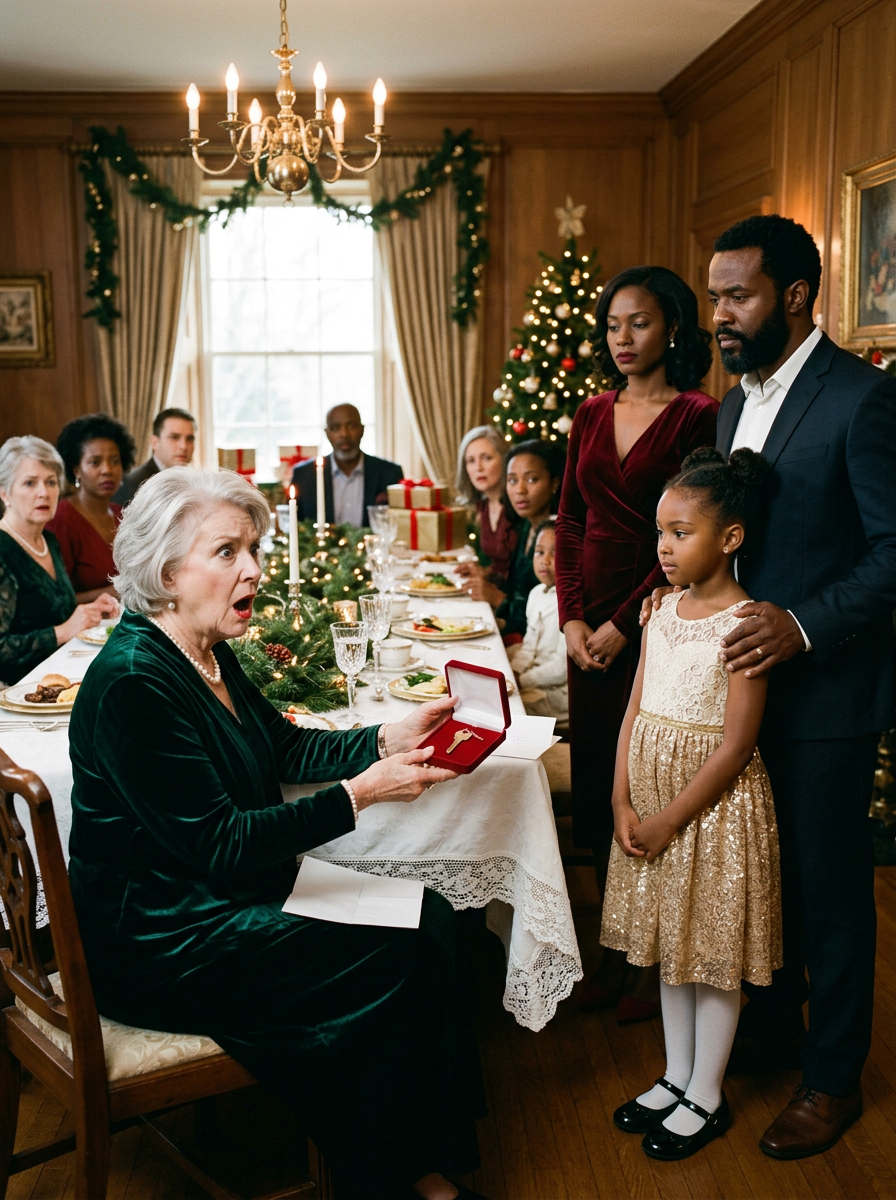
I never warned my mother-in-law that my daughter, whom she treated like a “stray dog,” had the power to exile her from our lives. On Christmas morning, she gave the other grandkids cash and iPads, but handed my daughter a cheap candle tagged “To Travis’s Girl.” The room went silent. My seven-year-old rose in her gold dress, calm and regal. “Grandma,” she said, “Dad told me to give this to you if you ever ignored me again.” She handed over a small red box. “Open it,” he said. She opened it and screamed.
Lorraine’s dining room looked perfect in the way a room can look perfect when everyone inside it is holding their breath. Pine garland hung over the doorway. Cinnamon rolls cooled beneath foil. The chandelier flashed against silver napkin rings, while outside, a small American flag tapped the porch rail in the winter wind.
Inside, everyone knew Lorraine’s rules: smile, stay polite, and never challenge her when she decided somebody needed to remember their place.
That Christmas, she chose my daughter.
Zia sat beside me in the gold dress Travis had steamed twice before we left. She was seven, her black Mary Janes tucked beneath the chair, both hands folded in her lap. Before we went inside, Travis had wiped a scuff from one shoe and murmured, “She deserves one holiday where she feels chosen.”
Lorraine had spent three years making sure she didn’t.
Zia was my daughter from my first marriage, but Travis never treated that like an asterisk. He packed her lunches, knew which stuffed rabbit had to face her bedroom door, and could tell her real laugh from the careful little one she used around adults who made her nervous.
Lorraine never called her granddaughter.
She called her “Travis’s girl,” “your child,” or “that sweet little visitor.” Always almost family. Never family.
At 8:47 a.m. on December 25, Lorraine began handing out presents like she was directing a ceremony. One cousin opened an iPad. Another got the same. The older kids pulled thick envelopes of cash from shiny cards.
Then Lorraine looked at Zia.
“Oh. Zia.”
She held out a thin drugstore gift bag with a crooked bow. “This is for you, sweetheart. I didn’t want you to feel totally left out.”
Zia accepted it with both hands. She carefully lifted the tissue paper.
Inside was a cheap vanilla candle.
The candle wasn’t what hurt.
The handwritten tag was.
To Travis’s Girl.
A fork stopped halfway to someone’s plate. One cousin stared at the carpet. The little dog beneath the table backed away from the chair legs. Beside me, Travis crushed the side of his paper coffee cup without seeming to notice.
Lorraine kept smiling, already pretending the insult was too small for decent people to mention.
I whispered Travis’s name.
He leaned toward me. “I told her to give Mom the red box if this happened again.”
“What red box?”
“The one in her overnight bag.”
I stared at him. “You planned this?”
“No,” he said. “I prepared for it.”
Later that night, at 9:12 p.m., I found Zia sitting on the guest-room bed with the candle in her lap. Her gold dress was wrinkled, and she kept studying that tag as though the words might change if she stared long enough.
“Mom,” she asked, “am I only Dad’s girl?”
Before I could answer, Travis knelt in front of her.
“You are my daughter,” he said. “No tag gets to decide that.”
Then he reached into her overnight bag and placed a small red velvet box in her hands.
“If Grandma ever makes you feel invisible again, you decide whether she gets this. Not me. Not your mom. You.”
Zia turned the box over. “Will she be mad?”
“Probably.”
“Will you still be my dad?”
Travis looked wrecked for half a second. “Always.”
The next morning, Lorraine hosted brunch. The table had been reset with white dishes, silver napkin rings, and handwritten place cards.
Everyone had a name.
Except Zia.
Her card said: Guest.
Zia saw it at the same moment Travis and I did. She didn’t cry or ask us to fix it. She reached into the tiny purse Travis had given her, wrapped both hands around the red velvet box, and stood.
She crossed the dining room while every aunt, uncle, cousin, and in-law watched.
“Grandma,” Zia said, clear enough for the far end of the table to hear. “Dad told me to give this to you if you ever ignored me again.”
Lorraine’s polished smile tightened. “Well, isn’t that dramatic.”
Travis stood behind our daughter.
“Open it,” he said.
Lorraine lifted the lid, still looking smug, as if she already had a speech prepared about sensitive children and modern parenting.
Then she screamed.
The cousin by the window flinched. Everyone leaned forward.
Inside the red velvet box sat one small brass key and a folded white card that began—
Type “KEY” and I’ll continue.
(I know you’re curious about the next part, so please be patient and read on in the comments below. Thank you for your understanding of the inconvenience.
PART 2
The folded card beneath the brass key began with four words.
Mom, this is goodbye.
Lorraine read the sentence twice. Then she looked at Travis as if he had struck her.
The key was the spare to our house. Lorraine had used it for years, usually without asking. She let herself in to rearrange our kitchen, criticize my laundry, or leave gifts for Travis while bringing nothing for Zia.
Travis had changed the locks on Christmas morning.
The card told her why.
Zia is my daughter. You have been warned privately, patiently, and repeatedly. If you cannot welcome her as family, you no longer have access to ours. There will be no visits, holidays, or unannounced entries. Zia may choose one day to offer you another chance. Until then, this key opens nothing.
Lorraine’s scream was not grief. It was outrage. The room went completely still.
“You gave a child authority over me?”
“No,” Travis said. “Your behavior did this. Zia only decides whether the door ever opens again.”
Lorraine turned toward the relatives around the table. “Is everyone hearing this? He’s throwing his mother away for someone else’s child.”
Zia stood very still in her gold dress.
Travis moved beside her. “Say that again, and we leave before you finish the sentence.”
Lorraine laughed bitterly. “She is not your blood.”
“She is my daughter by law, by promise, and by choice.”
That was the second thing Lorraine had not known. Travis’s adoption of Zia had become final three months earlier. We had planned to tell the family after the holidays, but Lorraine had turned belonging into a public contest.
Travis placed a copy of the adoption decree beside her plate.
The dining room erupted. One aunt whispered, “Oh, Lorraine.” An uncle pushed his chair back. Lorraine snatched up the decree and scanned it as though she could find a clause that made our family temporary.
“You did this without telling me?”
“It wasn’t yours to approve.”
She pointed at me. “This was her plan.”
I had spent three years trying to earn peace from a woman who treated kindness like surrender. I was done auditioning.
“My plan was to raise my daughter around people who love her,” I said. “You removed yourself from that list.”
Lorraine demanded that Travis take back the card. When he refused, she shoved the brass key across the table. It spun past the silver napkin rings and stopped in front of Zia.
Zia picked it up.
“Grandma,” she said quietly, “I didn’t want your house or your presents. I wanted you to write my name.”
No one moved.
Lorraine had a reply for every adult, but none for the child she had humiliated.
We left before brunch was served. Travis carried Zia’s overnight bag. I carried the cheap candle, because Zia said she did not want Lorraine throwing it away and claiming she had never given it.
In the car, Zia asked whether changing the locks meant we hated Grandma.
“No,” I said. “It means love does not require us to leave the door open for hurt.”
For eleven days, Lorraine did not contact us.
Then Zia’s school called.
A woman claiming to be her grandmother had arrived at dismissal with an old emergency-contact card and demanded to take her home.
PART 3
The school secretary kept Lorraine behind the locked office doors while Zia waited with her teacher.
Travis and I arrived at the same time. He went to Zia. I went to the office.
Lorraine stood at the counter in a camel coat, clutching a gift bag. She had brought the iPad Zia did not receive at Christmas.
“There,” she said when she saw me. “Now no one can say I treated her differently.”
“You are not authorized to pick her up.”
“I’m her grandmother.”
“You called her a guest twelve days ago.”
The principal asked Lorraine to leave. She refused until a school resource officer explained that the next request would come with a trespass notice.
Outside, Lorraine tried to press the gift into my hands.
“I only wanted five minutes with her.”
“You tried to remove my child from school without our permission.”
“She needs to understand what you’re doing to this family.”
That sentence ended any doubt I had. Lorraine had not come to apologize. She had come to recruit a seven-year-old into defending her.
We removed her from every school and medical form. Travis sent one written message: Do not approach Zia again. Any future contact must come through us.
Lorraine responded in the extended-family group chat. She accused me of isolating Travis, using Zia to punish her, and turning a “minor Christmas misunderstanding” into cruelty toward an elderly mother.
For once, Travis did not soften his answer.
He posted a photograph of the place card marked Guest beside the adoption decree.
Then he wrote: My mother was given private chances for three years. She chose to humiliate my daughter in public. We are protecting a child, not punishing an adult.
Several relatives left the chat. Others called us privately and admitted Lorraine had always needed one person at every gathering to sit below everyone else. For years it had been a sister-in-law, then a widowed cousin. When I married Travis, she chose me. When she realized I would endure it to keep the peace, she moved to Zia.
Her power depended on everyone treating each insult as too small to challenge.
A week later, a certified letter arrived from an attorney.
Lorraine was petitioning for grandparent visitation. The filing described a close, loving bond with Zia and claimed we had abruptly severed it after manipulating Zia into participating in an adult dispute.
Attached were photographs of Lorraine and Zia at birthdays and summer cookouts. Every photograph had been cropped. I was removed from one. In another, Travis had been cut away so that Lorraine appeared to be holding Zia alone.
The petition was dishonest, but it frightened me. A stranger reading it would see a grieving grandmother and a smiling child.
Our attorney told us Lorraine’s case was weak. She had never lived with Zia or cared for her regularly. Still, allegations had to be answered.
Then a child-welfare investigator knocked on our door.
Someone had reported that Travis pressured Zia to reject relatives and rewarded her for delivering threatening messages. The red box, meant to return control to a hurt child, had been described as evidence of emotional abuse.
The investigator interviewed us separately. She inspected Zia’s room, pantry, school records, and adoption file. Then she asked to speak with Zia alone.
I sat in the kitchen gripping the cheap vanilla candle while my daughter answered questions behind a closed door.
Afterward, the investigator said she saw no safety concern. She could not identify the caller, but Lorraine had repeated almost identical language in her court filing.
That evening, Travis listened to an old voicemail from his mother. She had left it the day after the school incident.
“You can stop all of this,” she said. “Bring Zia to me, make her apologize, and remind her who was here first.”
Our attorney submitted the voicemail.
Lorraine’s lawyer withdrew from the case two days later.
We thought that would end it.
Instead, Lorraine found the one person who could frighten us more than any attorney.
She contacted Zia’s biological father.
PART 4
Marcus had not seen Zia since she was two.
He had struggled with addiction, missed visits, and eventually signed away his parental rights so Travis could adopt her. His decision was painful, but it had also been honest. He said Zia deserved a father who was present every day, not one who appeared between disappearances.
Lorraine sent him money and a plane ticket.
We learned that from a photograph she posted online. She stood beside Marcus outside the county courthouse, her hand looped through his arm. The caption read: Truth has finally arrived.
The next morning, Marcus filed a statement claiming he had been pressured into consenting to the adoption.
Our attorney warned us that reversing a finalized adoption was extraordinarily difficult. But Lorraine did not need to win to hurt us. She needed hearings, interviews, and enough uncertainty to make Zia feel temporary again.
Zia noticed the whispered phone calls. She saw Travis scanning legal documents after dinner.
“Can Grandma make Dad stop being my dad?” she asked.
Travis knelt in front of her, just as he had on Christmas night.
“No one gets to erase us.”
It was a promise, not a prediction, and all three of us knew the difference.
Lorraine’s new filing included a letter from Marcus. He claimed I had kept him from Zia and that Travis used money to push him aside. None of it was true, but Marcus knew enough details from Zia’s early childhood to make the story sound intimate.
At the emergency hearing, Lorraine wore navy blue and carried a handkerchief. She looked like a wounded matriarch instead of the woman who had labeled a child Guest.
Her attorney argued that we had engineered an adoption to isolate Zia from her biological family. He called the red box a “loyalty test administered by adults through a minor.”
Our attorney played Lorraine’s voicemail and showed the school report. She presented three years of messages in which we asked Lorraine to include Zia fairly.
The judge listened without expression.
Then Marcus entered the courtroom.
Zia was not present. We had refused to let Lorraine turn her into an exhibit. Still, when Marcus looked toward us, I felt the old terror of losing my daughter tighten around my ribs.
He took the witness stand and swore to tell the truth.
Lorraine smiled at him.
Her attorney asked whether he regretted signing the adoption consent.
“Yes,” Marcus said.
Travis’s hand closed around mine.
Marcus said he had been sober for nine months. He had a job, an apartment, and a church support group. He said he thought about Zia every day.
Then Lorraine’s attorney asked the question she had brought him there to answer.
“Did Zia’s mother or adoptive father pressure you to surrender your parental rights?”
Marcus looked at Lorraine.
She gave him the smallest nod.
He reached inside his jacket and pulled out an envelope.
“Yes,” he said. “Someone pressured me.”
He opened the envelope and placed a cashier’s check on the witness rail.
“But it wasn’t them.”
PART 5
The cashier’s check was from Lorraine.
She had paid Marcus ten thousand dollars before he signed the statement challenging the adoption. A second ten thousand was promised if the court ordered a new custody review.
Marcus had accepted the first check because, in his words, he wanted proof no one could explain away.
Then he handed the judge his phone.
He had recorded Lorraine telling him what to write.
“She doesn’t belong to Travis any more than she belongs at my table,” Lorraine said on the recording. “Help me undo this, and I will help you start over.”
Marcus asked what would happen to Zia if the adoption were overturned.
Lorraine answered, “Once my son is free of them, the girl can go wherever she would have gone without him.”
She had never wanted a relationship with Zia. She wanted leverage over Travis, and she was willing to make a child fatherless to regain it.
The courtroom remained silent after the recording ended.
Marcus testified that no one had pressured him to consent to the adoption. Travis had paid for independent counsel so Marcus understood every right he surrendered. Marcus said signing had been the hardest responsible act of his life.
“I regret that I wasn’t the father she needed,” he said. “I don’t regret that she has one.”
Lorraine stopped smiling.
The judge dismissed her petition. She referred the check and recording to the district attorney for review and entered an order prohibiting Lorraine from contacting Zia or approaching her school.
Outside the courtroom, Lorraine called Marcus a liar. Then she turned on Travis.
“You would do this to your own mother?”
Travis stood between her and me.
“No, Mom. You did it to yourself every time you asked a child to accept less so you could feel like more.”
She told him he would come crawling back when I left him. She said Zia would grow up and forget him. She reached for his sleeve, but he stepped away.
“You kept asking who was here first,” he said. “I’m choosing who will be here last.”
We walked away together.
The child-welfare case closed as unfounded. The district attorney charged Lorraine with bribery and filing a false statement. She eventually accepted probation, community service, and a permanent protective order rather than risk trial.
The legal consequences mattered, but they were not what exiled her from our lives.
The truth did that.
Once relatives heard the recording, they stopped defending her behavior as tradition or bluntness. The aunt who had whispered at Christmas sent Zia a letter apologizing for remaining silent. Two cousins admitted their parents had warned them never to contradict Lorraine if they wanted to stay in her will.
For the first time, family gatherings happened without anyone holding their breath.
Marcus returned the money. He did not ask to undo the adoption or demand a place in Zia’s life. He wrote her a letter for us to keep until she was older, and he continued working on his sobriety.
Six months later, Zia asked to read it.
Marcus told her that leaving had been his failure, not hers. He thanked Travis for becoming the father he had been unable to be. He did not ask Zia to forgive him. He only told her the truth and left the choice of future contact with her.
She folded the letter and put it in the drawer beside the brass key.
We had kept the key from Lorraine’s red box. It no longer opened our house, but Zia said throwing it away would make it feel as if Christmas had won.
Instead, Travis mounted it in a small frame. Beneath it, he placed a new card with one word.
Home.
The following Christmas, we stayed in our own house. There were cinnamon rolls under foil and gold ribbons on the tree. No gifts were ranked by price. Every place card carried a name.
Zia helped write them.
She made one for me, one for Travis, and one for herself. On hers, she wrote her full name—the last name she now shared with the man who had chosen her.
Before dinner, Travis gave her a small box. Inside was not an iPad or cash, but a gold key on a thin chain.
“What does it open?” she asked.
“Nothing yet,” he said. “Someday, whatever door you choose.”
Zia fastened it around her neck. Then she carried the framed brass key to the entryway and hung it where every guest would see it.
Lorraine had used one word to make my daughter feel temporary.
My daughter answered by building a home where nobody had to earn their name.