PART 1
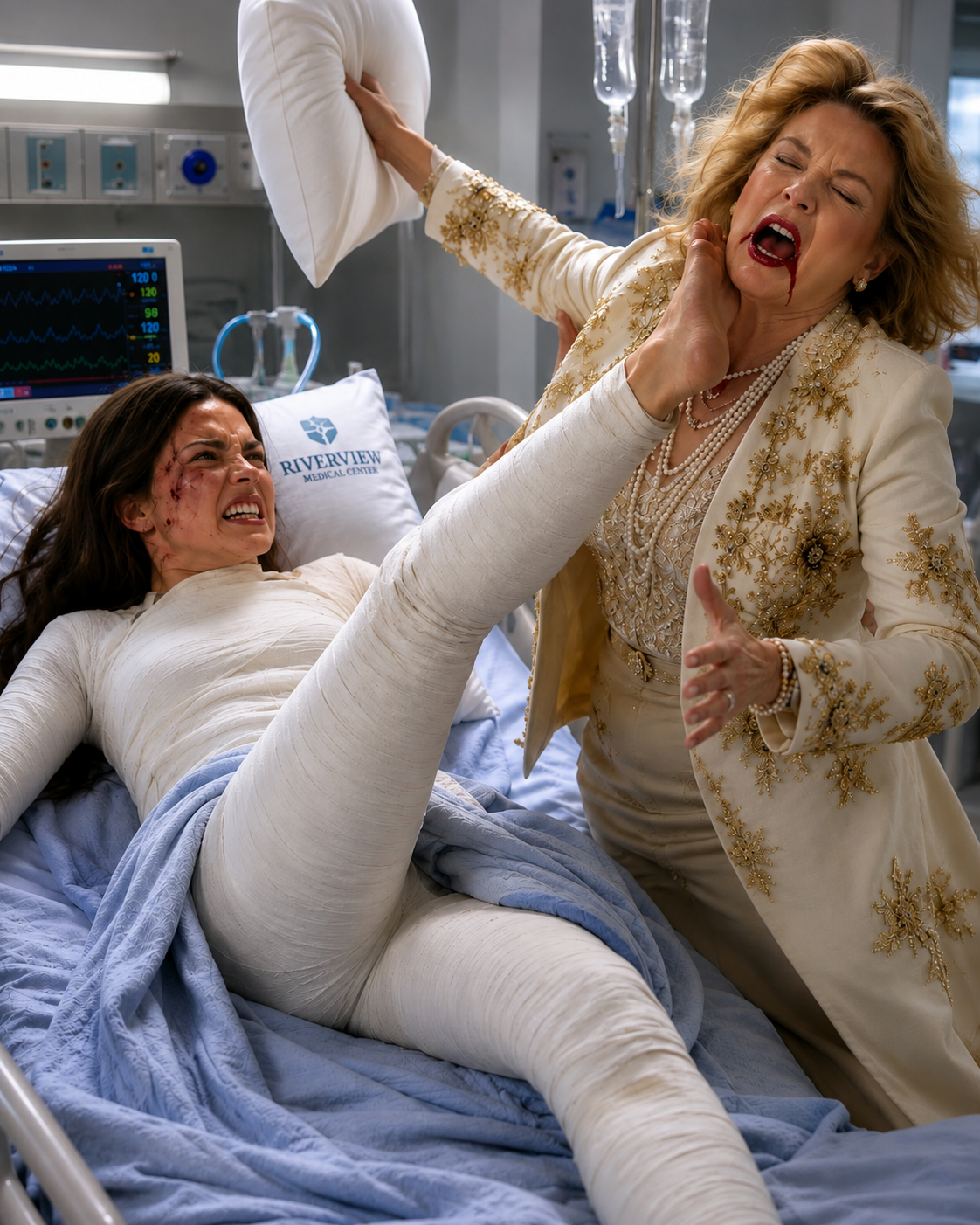
My mother-in-law pressed a pillow over my face while I lay trapped inside a full-body cast, whispering that I should have died in my “accident.” She thought I couldn’t move, couldn’t fight back, and couldn’t prove a thing. What she didn’t know was that I had spent the last forty-eight hours waiting for her to say those exact words.
Three days earlier, everyone told me I was lucky to be alive.
The doctors called it a terrible fall. My husband called it an accident. The police had closed the report before I even woke up.
Only I knew someone had shoved me off that second-floor balcony.
My name is Claire Morgan, and I had been married to Ethan for just eighteen months. To everyone else, he was charming, successful, generous—the husband people assumed I was lucky to have.
At home, there was always someone else in our marriage.
His mother.
Margaret made the decisions. Ethan let her. She never bothered hiding what she thought of me, either. I was an opportunist. A mistake. A woman who didn’t deserve her son’s name.
Then I found messages from another woman.
When I confronted Ethan that night, he smiled like I’d accused him of forgetting milk. I remember his face. I remember the balcony railing behind me. I remember how quickly his expression changed when I refused to drop it.
Then came the shove.
The railing.
The pavement rushing up.
When I woke in the hospital, pain seemed to belong to every inch of me. The doctors had immobilized me inside a rigid body cast because my spine needed protection. I couldn’t sit up. I couldn’t turn over. I couldn’t even lift my arms without help.
Everyone who visited looked horrified by how helpless I was.
Margaret looked satisfied.
She came every day.
She came during visiting hours. She sat beside my bed and pretended to pray. She lowered her voice whenever a nurse passed the doorway.
Then, when we were alone, she whispered things no worried mother-in-law would ever say.
“You’re harder to get rid of than I expected.”
I couldn’t prove it. Not then.
So I stopped reacting.
I listened. I counted. I waited.
Forty-eight hours before Margaret finally made her move, Detective Mason had come to see me. He asked one question.
“Do you believe she’ll come back to finish the job?”
“Yes.”
That was enough.
Two days later, after the nurses completed their rounds, Margaret entered my room and quietly locked the door.
She walked to my bedside with the same calm face she’d worn while pretending to pray. Then she picked up the pillow beside my head.
“You should’ve died on that sidewalk,” she whispered.
The pillow came down over my face.
“My son deserves another chance.”
I couldn’t scream. I couldn’t push her away. Under the cast and braces, my body might as well have belonged to someone else.
So I counted.
One.
Two.
Three.
At ten, I pressed the tiny emergency switch concealed inside the brace around my thumb.
It wasn’t connected to the nurses.
The door burst open.
Detectives rushed into the room while Margaret still had both hands gripping the pillow. She froze. One detective pulled her away and placed her in handcuffs while another took the pillow as evidence.
For the first time since I hit that pavement, I thought I could finally stop being afraid.
Then Detective Mason looked at me differently.
Not relieved.
Not finished.
“Mrs. Morgan… there’s something you deserve to know before we question your husband.”
He reached under his arm, pulled out a worn manila folder, and placed it on my hospital bed.
PART 2
Detective Mason opened the manila folder without taking his eyes off me.
Inside was a photograph of a woman standing beside Ethan on the steps of a courthouse. She had dark hair, a careful smile, and one hand resting lightly on his arm. Ethan looked younger, but the expression on his face was the same polished warmth he wore in every photograph with me.
The woman was wearing my necklace.
It was a small gold locket Ethan had given me on our first anniversary. He had said it belonged to his grandmother and that Margaret had saved it for the woman he was meant to marry.
“Who is she?” I asked.
Mason glanced toward the hospital door, where another detective had followed Margaret into the hallway.
“Her name was Rebecca Hale,” he said. “She married Ethan Morgan six years ago.”
My mouth went dry. Ethan had told me he had never been married before. He said he had spent his thirties building his company and caring for Margaret after his father died.
“What happened to her?”
Mason turned the photograph over. Three words had been written across the back in red ink.
He pushed me too.
The letters were uneven, as if the writer’s hand had been trembling.
“Rebecca fell down the basement stairs at the Morgans’ old house,” Mason said. “Her death was ruled accidental. The report says she had been drinking.”
I stared at Rebecca’s face. She did not look like a stranger anymore. She looked like a warning that had arrived six years too late.
“Who wrote that?”
“We don’t know. The photograph was mailed to the department yesterday with no return address.”
“Where is my husband?” I asked.
“He’s downstairs with an officer. He thinks we’re questioning him about his mother.”
He set a small recorder beside my hand. Then he asked me to tell him every detail I remembered from the night I fell.
This time, I did not call it a fall.
I described the messages I had found on Ethan’s tablet. They were from a woman saved under the name Daniel Price, but the messages were intimate. She wrote about an apartment, a shared bank account, and Ethan’s promise that he would be free soon.
I told Mason how Ethan had followed me onto the balcony after I confronted him. How his smile disappeared when I said I had photographed the messages. How he asked where my phone was.
Then he stepped close enough for me to smell his cologne.
“You have no idea what you’re interfering with,” he had said.
His hands struck my shoulders a second later.
“Where is that phone now?” Mason asked.
“I don’t know. It was in my robe pocket before he pushed me.”
No phone had been logged among the belongings brought to the hospital.
Mason stood. “If Ethan took it, he may still have it.”
Before he reached the door, I remembered something else. The messages had mentioned a storage unit. Number 214. I had assumed it belonged to the other woman.
Mason wrote the number down.
Two hours later, Ethan came into my room.
He wore a gray suit and carried white roses. His eyes went immediately to the empty chair where Margaret usually sat.
“The police are making a terrible mistake,” he said. “Mom panicked. She thought you were suffering.”
I looked at the roses and thought of Rebecca wearing my locket.
“She pressed a pillow over my face.”
“She’s confused. You know how devoted she is to me.”
To him. Not to us. Not to the truth.
Ethan placed the flowers on the table and leaned over me. “Tell the police you misunderstood.”
“I want my phone,” I whispered.
For one instant, his gaze hardened.
“It was destroyed in the fall.”
“I thought maybe the police had it.”
“They don’t.” He answered too quickly.
Then he kissed my forehead and promised to return after he found Margaret a lawyer.
As he walked out, Detective Mason listened from the adjoining supply room.
The moment the door closed, he stepped back inside.
“He knows exactly where your phone is,” he said.
I looked at Rebecca’s photograph on the blanket between us.
“And I think I know where he hid it.”
PART 3
Storage unit 214 was rented under the name Daniel Price.
The name from Ethan’s secret messages was not a lover at all. It was an identity he had built from pieces of two dead relatives: his father’s middle name and Margaret’s maiden name.
Detective Mason obtained a warrant before sunrise. By then, Margaret had asked for a lawyer and refused to answer questions. Ethan had left the hospital and driven directly to a private storage facility across town.
He arrived twenty minutes before the police.
The security camera showed him entering unit 214 carrying a black duffel bag. It showed him leaving without it.
Inside, detectives found my missing phone, Rebecca Hale’s laptop, three prepaid phones, copies of insurance documents, and a metal cashbox containing jewelry.
The locket around my neck had a matching twin in that box. Rebecca’s sister, Laura, identified it.
Laura was also the person who had mailed the photograph.
She had spent six years believing Rebecca’s death was not an accident. Rebecca had called her three days before she died and said Ethan had become controlling after she discovered money missing from an account. She said Margaret watched everything she did and warned her never to embarrass the family.
Laura went to the police after Rebecca’s death, but there was no physical evidence of a crime. Then she saw a local news report about my fall. The report included Ethan’s name and a photograph of Margaret leaving the hospital.
Laura recognized the pattern.
But a pattern was not yet a confession.
The prepaid phones revealed that Ethan had been communicating with himself under several false names. The romantic messages I found were staged. They were meant for me to discover.
He had wanted a confrontation.
He had wanted me angry enough to follow him onto the balcony.
“What did he gain if I died?” I asked.
Mason placed an insurance document on the tray near my bed.
Four months earlier, Ethan had purchased a two-million-dollar accidental-death policy on me. The electronic signature looked like mine, but I had never seen the form.
Rebecca had carried a similar policy.
Ethan was arrested that afternoon for insurance fraud, evidence tampering, and obstruction while detectives continued building the assault case. He insisted the storage unit belonged to an employee. He said someone had planted my phone and Rebecca’s property.
Then his attorney produced something that frightened me more than his denials.
A medical report from two years earlier claimed I had suffered episodes of confusion and paranoia.
The doctor’s name was real. The appointment was not.
Someone had inserted false records into my medical file months before the balcony attack. The records described me accusing Ethan of infidelity without evidence. They also claimed I had once threatened to harm myself.
Ethan had not merely planned my fall. He had prepared a history that would explain it.
Margaret had helped. Her name appeared as the emergency contact who supposedly brought me to one of the appointments.
Then Laura called again.
She had found an old voicemail from Rebecca on a phone stored in a desk drawer. Most of it was difficult to hear, but Rebecca clearly said Margaret had taken her to a doctor she did not know.
The same doctor named in my false report.
Dr. Samuel Voss had retired the previous year. When detectives visited his home, he denied knowing Ethan or Margaret. Mason showed him the records.
Voss said the signature was not his.
The lie should have ended there.
Instead, a hospital administrator discovered that the records had been uploaded using the credentials of a nurse named Julia Mercer.
Julia was Ethan’s former fiancée.
Mason immediately ordered a review of every drug I had received.
One vial did not match the physician’s orders.
Someone had been giving me a sedative strong enough to slow my breathing—and Julia Mercer still had an access card that could open the secured doors on my floor.
PART 4
The hospital moved me to a guarded room under another name.
Only my medical team, Detective Mason, and Laura knew the new room number. My chart was removed from the public system, and an officer sat outside my door around the clock.
Julia Mercer disappeared before detectives reached her apartment.
Margaret finally agreed to talk.
She claimed Ethan manipulated everyone around him, including her. She admitted falsifying my medical history and helping him obtain the insurance policy, but she denied knowing he intended to push me.
When Mason asked about Rebecca, Margaret began to shake.
She recognized the handwriting.
It belonged to Julia.
Julia had mailed the photograph because she had learned Ethan was preparing to abandon her again.
“She wanted you to arrest him,” Margaret told Mason. “But she won’t let Claire testify. Julia knows he’ll blame everything on her.”
At 2:15 a.m., the fire alarm sounded.
Red lights flashed above the door. An announcement ordered staff to evacuate the floor. My nurse unlocked the wheels on my bed while the officer stepped into the hallway to check the stairwell.
Smoke began slipping beneath the door.
The nurse pushed my bed toward the service elevator. Patients were crying out as staff moved them into the corridor. Sprinklers burst overhead, striking the floor and ceiling in hard silver sheets.
In the confusion, a woman wearing a respiratory therapist’s mask took hold of the opposite bedrail.
“I’ll help,” she said.
I knew her voice.
She was the woman who had adjusted my medication in the dark.
Julia.
I tried to warn the nurse, but the alarm swallowed my words. Julia pointed toward a side corridor and shouted that the main exit was blocked.
The nurse turned my bed.
Julia waited until we passed a storage alcove. Then she drove a syringe into the nurse’s shoulder.
The nurse collapsed against the wall.
Julia released the brake and pushed me through a pair of swinging doors. My cast made me helpless against every turn. The ceiling lights streaked above me as the bed gathered speed.
She shoved me into an empty procedure room and locked the door.
Julia removed her mask.
She was younger than me, with exhausted eyes and rain-soaked hair tucked under a surgical cap. She held another syringe between two fingers.
“You ruined everything,” she said.
“I didn’t know you existed.”
“You weren’t supposed to wake up after the balcony.”
The words settled between us.
A confession, spoken without fear because she believed I would never repeat it.
Julia moved closer. She said Ethan had promised they would leave together after collecting my insurance. He had told her Margaret would support their story, just as she had after Rebecca died.
But after my fall, Ethan stopped answering Julia’s calls. He moved the prepaid phones into storage and prepared to blame her for the forged records.
“So you sent the photograph,” I said.
“I wanted him frightened. I wanted him to need me again.”
Outside, someone struck the locked door.
Julia looked toward the sound, then back at me.
“You think they’ll believe you because you survived?” she asked. “He has records saying you’re unstable. His mother will change her story. And when I’m gone, every forged document leads to me.”
She leaned over the bed and uncapped the syringe.
I pressed the emergency switch inside my thumb brace.
Nothing happened.
Julia smiled.
“I removed the transmitter before they moved you.”
She raised the syringe above the IV port.
Then the pounding outside stopped.
For one terrible second, the entire room went quiet.
Julia pushed the needle into the line.
PART 5
I watched Julia’s thumb press the plunger.
Nothing entered the tube.
The IV line had been disconnected beneath the blanket twenty minutes earlier.
Detective Mason had suspected the fire alarm might be used to isolate me. Before the evacuation began, my nurse had switched me to a saline lock and tucked the loose tubing out of sight. The line Julia injected ended harmlessly against the sheet.
Julia did not notice.
She was too busy watching my face, waiting for panic to become unconsciousness.
“You were right about one thing,” I said. “Ethan planned to blame you.”
Her expression changed.
I told her detectives had found the prepaid phones and the forged records. I told her Margaret had identified her handwriting and described her role in Rebecca’s death.
“That’s a lie.”
“It’s what Margaret does. She protects Ethan by sacrificing the nearest woman.”
The handle turned behind her.
Julia spun toward the door just as it burst inward. Mason and two officers entered. One pulled Julia away from the bed while another took the syringe from her hand.
She fought until Mason told her the procedure room had an active ceiling camera with audio.
Her confession had been recorded.
Julia was charged with attempted murder, arson, assault, and conspiracy. Faced with the recording and Margaret’s statement, she stopped protecting Ethan.
Over the next week, she described everything.
Ethan had selected women with assets, limited close family, and reputations he could quietly undermine. Rebecca inherited a house from her father. Ethan persuaded her to sell it and place the proceeds in a joint account. When she discovered he had transferred most of the money, she threatened to report him.
He pushed her down the basement stairs.
Julia altered Rebecca’s medical records to suggest alcohol misuse. Margaret cleaned the broken glass from the kitchen and poured liquor on Rebecca’s clothing. Ethan called emergency services and cried convincingly enough that the first officers saw a grieving husband instead of a practiced liar.
The insurance company paid him eight hundred thousand dollars.
He used part of it to start the business that made him appear successful when I met him.
My marriage had been financed by Rebecca’s death.
Julia admitted creating the false messages I found. Ethan chose the night I would discover them. He knew I was arranging flowers on the balcony for a dinner party and expected me to confront him near the railing.
After Ethan pushed me, he took my phone from my robe and deleted the messages. He overlooked the cloud backup because he believed Julia had disabled it.
She had not.
Detectives recovered the photographs I took of the messages, along with an audio fragment recorded when my phone struck the balcony floor.
Ethan’s voice was faint but unmistakable.
Where is your phone, Claire?
Then came my answer: You’re not getting away with this.
A scuffle followed. Ethan said one final sentence before the sound of the railing and the rush of air.
Rebecca said the same thing.
Ethan was charged with my attempted murder and Rebecca’s murder, along with conspiracy, fraud, forgery, and evidence tampering. Margaret pleaded guilty to attempted murder, conspiracy, and obstruction. Julia entered a guilty plea and testified against both of them.
The trial began eleven months later.
I attended every day of the trial.
Then Laura took the stand.
She spoke about her sister as a person, not a case file. Rebecca loved old jazz records, burned every pie she baked, and called whenever she saw the first snow of winter. Laura described the last voicemail and the six years she spent asking people to listen.
Ethan finally lowered his eyes.
When it was my turn, his attorney asked whether pain medication had affected my memory. He brought up the false reports. He suggested I resented Ethan and had convinced myself he pushed me.
I answered every question calmly.
Then the prosecutor played the recording.
Rebecca said the same thing.
The jury heard Ethan connect me to the dead wife he claimed he never had.
He received life in prison without the possibility of parole for Rebecca’s murder, with additional consecutive sentences for the crimes against me. Margaret received twenty-two years. Julia received thirty years under the terms of her plea agreement.
After sentencing, Laura met me on the courthouse steps. She carried a small velvet box.
Inside was the locket Rebecca had worn in the photograph. Police had recovered it from the storage unit and released it to her family after the trial.
“I want you to have it,” Laura said.
I closed the box and placed it back in her hands.
“It belongs with someone who loved her.”
The civil court returned the proceeds Ethan had stolen from Rebecca’s estate. Laura used part of the money to establish a legal fund for women whose abuse had been disguised as accidents. I donated the insurance settlement from the hospital and later joined its board.
My divorce became final two weeks after Ethan’s sentencing.
I sold the house with the balcony. I kept nothing Margaret had chosen for me and nothing Ethan had given me. In my new apartment, the windows opened onto a small courtyard filled with roses I planted myself.
On the first anniversary of the night I survived, I walked outside without my cane.
Laura stood beside me. Detective Mason watched from the gate. The people who had believed me were there, but the steps were mine alone.
Ethan had mistaken my trust for blindness, my injuries for silence, and my stillness for defeat.
I took one more step into the sunlight, carrying my own name and no one else’s permission.