A text story
At eleven o’clock at night, my husband’s daughter arrived with her husband and two enormous suitcases.
“Dad said we’re moving in,” she announced.
Then she handed me a list of household duties as though I were the maid in my own home. Typed. Printed. Laminated at one corner where she’d clearly run out of patience with the machine.
My husband said nothing.
So I smiled and said, “All right.”
At six the next morning I gave them my real answer.
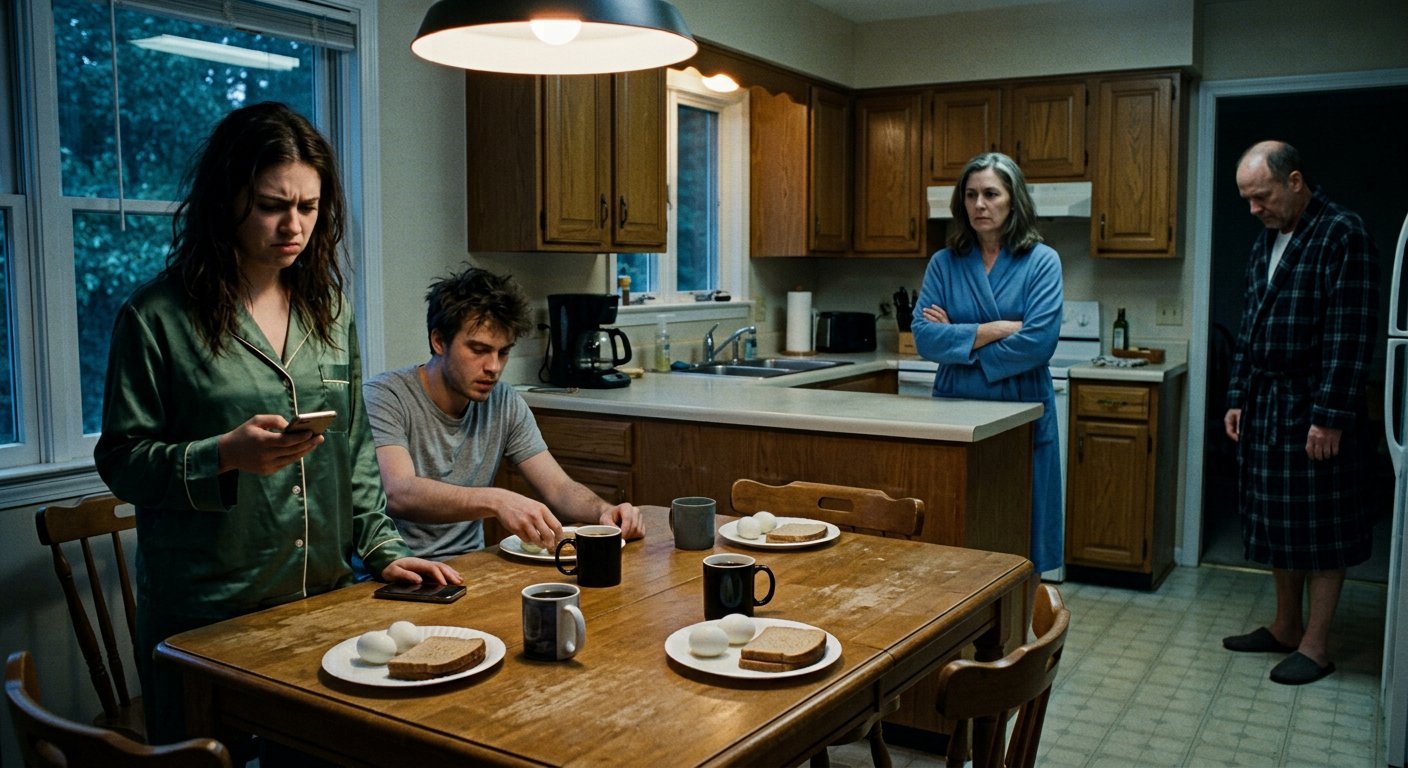
I served breakfast on paper plates. Two boiled eggs, plain toast, black coffee. No butter, no jam, no bacon, no fried potatoes. Nothing greasy enough to upset the delicate stomachs of Madison Clarke and her husband Evan, per item four of the laminated list.
Madison came into the kitchen first, in silk pajamas, looking at her phone.
“What is this?”
“Breakfast.”
She looked down at the plate with real disgust. “Dad told you I need protein pancakes.”
I glanced past her at Robert, tightening the belt of his robe, who would not meet my eyes.
“Your list said no greasy food,” I said pleasantly. “This is not greasy.”
Evan wandered in behind her, yawned, sat down, and ate everything on his plate in about ninety seconds.
Then he said, “Thank you, Ms. Ferreira. This is the first hot food I’ve had in nine days.”
Madison’s head turned so fast I heard her neck.
And Evan — twenty-nine years old, in a T-shirt with a company logo on it that I later learned had gone out of business in November — looked at his wife’s face and said, “Maddie. She’s going to find out in a week anyway.”
Here’s what came out over the next forty minutes at my kitchen table, mostly from Evan, because Madison couldn’t speak for the first fifteen of them.
They weren’t moving in. They’d been evicted eleven days earlier. The two enormous suitcases were not a portion of their possessions; they were all of them. Everything else had gone into a storage unit in Reston that they were three weeks behind on.
Evan’s company folded in November. Madison had been laid off in January from a marketing job she’d told everyone she quit. They’d been living on credit cards since Christmas, then on a car, then on Evan’s cousin’s basement in Manassas until the cousin’s girlfriend put an end to it.
Nine days of gas station food. She’d been posting from restaurants she wasn’t eating in.
And the list — the laminated list, item four, the household duties, the protein pancakes — was a performance she had constructed at a rest stop on I-66 at nine o’clock that night, in a car, on her phone, and printed at a FedEx Office in Fairfax at a cost of $4.15, because she could not bear to arrive at her father’s house as a person who needed something.
She’d rather be resented as an entitled brat than pitied as a broke thirty-four-year-old.
So she’d walked into my kitchen at eleven at night and handed me a chore chart.
Now.
I want to be very careful here, because there’s a version of this where I come out looking wonderful, and that version is a lie.
I did not serve those eggs out of wisdom. I did not serve them as a lesson.
I served them because I was furious and I had found a way to be furious that couldn’t be called furious. That is exactly what boiled eggs on paper plates at six in the morning are. It’s aggression with an alibi. If she’d complained, I’d have held up her own list, and I’d have won, and I had been looking forward to it since about two a.m.
I’d stayed awake most of that night composing that breakfast the way other people compose a letter they never send.
The eggs happened to land in the right place. That was luck. I want to be honest that it was luck, because I have watched people tell this story back to me as though I’d known, and I didn’t know, and if Evan had been a different sort of man he’d have said nothing and I’d have spent six months escalating a war with a homeless woman in silk pajamas.
The other thing that came out at that table was about Robert.
He’d known. Madison had called him nine days earlier from the cousin’s basement and he’d said yes, come, and then he had said nothing to me for nine days, and nothing at eleven o’clock at night, and nothing while his daughter handed his wife a laminated list.
I’ve been married to Robert for six years. His first wife died in 2013. He is a kind man and a coward in exactly one direction, which is his children, and I had known that in an abstract way and had never had it put on my kitchen table before.
I asked him why he hadn’t told me.
He said, “Because you’d have said yes.”
I said that wasn’t an answer, and he said, “It is, though. You’d have said yes and then you’d have known, and Maddie asked me not to tell you.” He looked at the table. “She’s my kid. She asked me for one thing.”
Which is how a sixty-four-year-old man ends up standing silently in a robe while his daughter humiliates his wife in order to preserve her own dignity, and everyone in the room is doing it out of love, and it is still completely unacceptable.
We had two very bad weeks about that. Not about Madison. About the nine days.
They stayed seven months.
I want to skip past the warm part quickly because it’s the least interesting: it got easier, then it got fine, then it got good. Evan is genuinely excellent company and put a new sill in the back bathroom that I’d been asking about since 2021. Madison and I did not become friends for about four months and then did, abruptly, over something stupid involving a vacuum.
What I’ll put down instead is the thing we made, because it’s the only part of this I’d hand to somebody else.
In the second week I threw the laminated list away and we wrote a different one. All four of us, at the table, and it took two hours and one argument.
HOUSE TERMS — agreed 14 Feb 1. Rent: $0 until either of you is working. Then $400/mo, into an account in YOUR name, for a deposit. Not to us. Ever. Do not argue. 2. Everybody cooks one night. Nobody comments on it. 3. No performing. If it’s bad, say it’s bad. If you need something, use the word. 4. R. does not carry messages between his wife and his daughter. Not one. If it’s about her, say it to her. 5. This ends when you want it to end, not when we do. M.C. / E.C. / R.F. / A.F.
Rule four is Robert’s, and he wrote it himself, and I nearly went through the floor.
They moved into a place in Sterling in September. Evan’s at a logistics firm; Madison went back to school part-time for something involving data that I do not understand and she explains to me anyway.
The $400 a month came to $2,800 by the time they left, which covered most of a deposit, and she tried to give it to us on the last day and I pointed at rule one and she said a word I won’t write down.
Two last things.
The first is that I kept the list. The laminated one. It’s in the drawer with the takeaway menus, and every so often I take it out and look at item four — no greasy food, we have delicate stomachs — written by a woman who had not eaten a hot meal in nine days, at a rest stop, at nine o’clock at night, to protect the last thing she had.
I don’t find it funny anymore. I did for a while.
The second is that Madison asked me, in about month five, why I hadn’t thrown them out that first morning.
And I told her the truth, which is that I very nearly did, and that the only reason I didn’t is that her husband said thank you.
Nine days of nothing, a woman handing out chore charts, a father in a robe saying nothing at all — and one twenty-nine-year-old man sat down in front of two boiled eggs on a paper plate and said thank you, out loud, to a stranger who had made them to be cruel.
She said, “That’s Evan.”
I said, “I know. Keep him.”
And she said, “I’m working on it,” which was the first entirely true sentence she had said to me since eleven o’clock on a Tuesday night.