A text story
My son didn’t invite me to his wedding.
He sent a group text to thirty people thanking everyone who supported him — his father, his stepmother, three uncles, a college roommate, a woman from his office who once lent him a car — and left my name off the list.
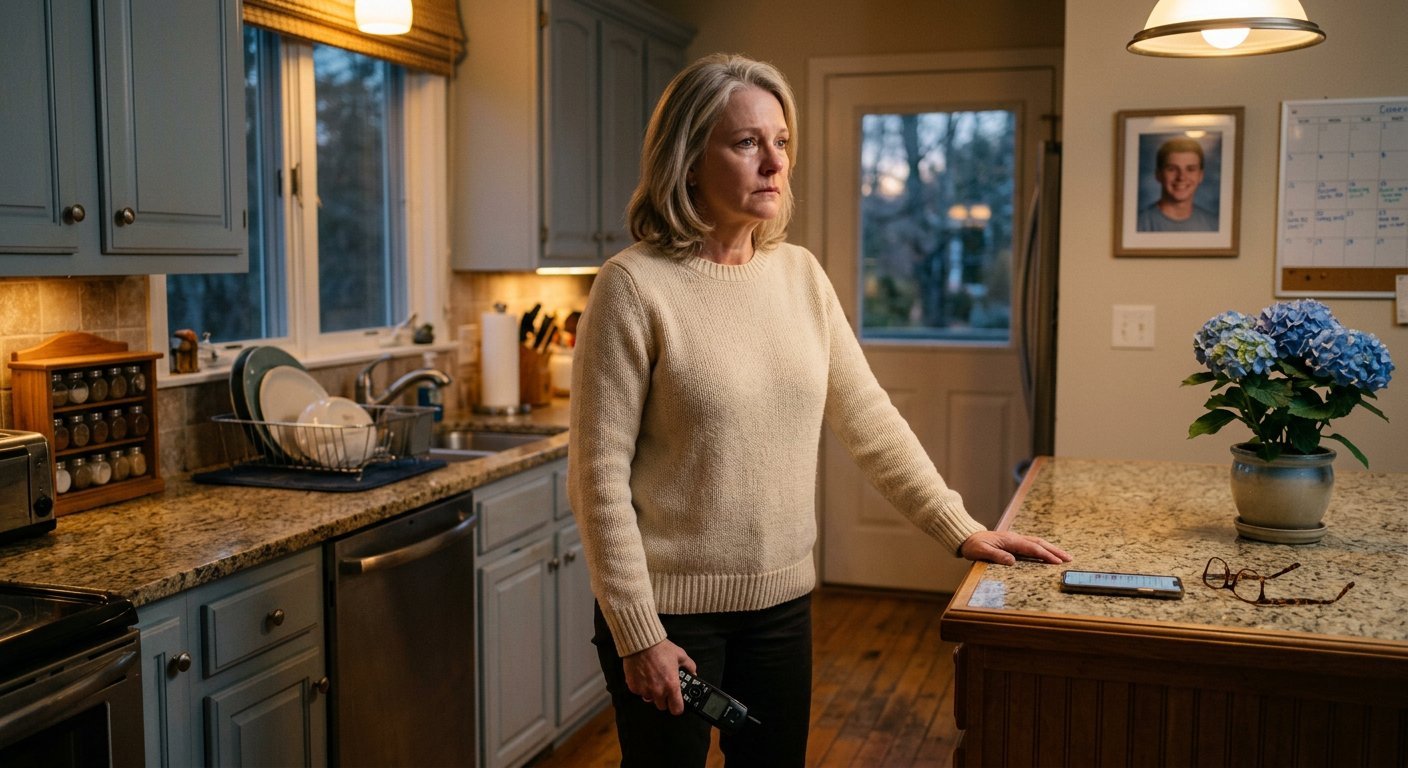
I read it four times looking for myself. I want you to picture that, because I’ve thought about it a great deal since: a fifty-nine-year-old woman standing in her own kitchen scrolling up and down a text message looking for her own name.
I didn’t cause a scene. I’ve never caused a scene in my life, which is either a virtue or the central problem, and I’m no longer sure which.
I paid the $14,000 venue deposit six months ago because he asked me to help him get started. He came to the house, he sat at the table, he said the word “help,” and I wrote a check the same afternoon out of the account I’d been building since 2011 for exactly this kind of thing.
Then yesterday the venue manager called the house to confirm the final setup — linens, the head count, whether we wanted the terrace open.
And partway through she said, in the neutral voice of a woman reading a screen, that my son had stopped by the office on Tuesday to change the primary host name on the official contract.
I asked whose name he’d put down instead.
She read it off the screen. It was my ex-husband’s new wife.
Bettina. Married to Roy for nine years. A perfectly pleasant woman who has never done a single thing to me and whose name was now on a contract I had paid for.
I got off the phone. I stood in the kitchen for ten minutes.
Then I called the manager back and gave her one instruction.
Everyone assumes they know what it was.
People hear this story and their whole face changes and they lean in and say you pulled the deposit — and I understand why, because that’s the story that ought to follow. That’s the shape the thing is asking for.
The instruction I gave her was:
“Don’t tell him I know. Don’t tell anyone I called. Do not let my name come up in that office again before the wedding.”
She said, “Ma’am, I need to be straight with you — you’re the payor of record. I have you down as the contracting party for the deposit.”
I said, “Then change that too. Put it under her name. I’ll sign whatever you need.”
There was a long pause and she said, very carefully, “That’s not usually the direction these calls go.”
Here’s why.
I have had a long time to think about the difference between being wronged and being owed, and I want to lay out what I actually knew standing in that kitchen, because it wasn’t nothing and I wasn’t being noble.
I knew my son. Denny is thirty-one. He is not cruel. He is the most conflict-avoidant human being I have ever produced or met, and he has been managing his father since he was nine years old.
And I knew what a name on a contract is. It isn’t love. It’s logistics. It’s who the venue calls when the linens are wrong.
His father was paying for the bar and the band. His father had, I would have bet the house, made some remark about being “just a guest” at a wedding he was writing checks for. And Denny — who has been buying peace with his father his entire life, in small increments, the way you feed a meter — had made a swap on a piece of paper he thought nobody would ever look at.
That was the theory. I want to be clear that I did not know it. I had one phone call and thirty-one years of evidence.
So I didn’t pull the deposit, because the deposit wasn’t for the party. It was for my son to be married in a room with a terrace, and that remained true whether or not my name was in a field on a screen, and blowing it up would have cost him the room and cost me the last thing I actually wanted, which was to find out whether I’d been erased or merely rearranged.
And — this is the part I have to include — there was something else in it. I wanted to know how far he’d go. I let it run. Some of that was patience and some of it was a test, and I’ve stopped pretending those were the same thing.
I did not go to the wedding. I wasn’t invited.
I want to state that plainly because people keep expecting a scene at the back of a church and there wasn’t one. I spent that Saturday repotting things I did not need to repot and going to bed at eight forty.
He came to the house eleven days later.
He stood in the kitchen — the same kitchen — and said, “The venue sent the final invoice packet to Bettina and she opened it in front of Dad.”
Every line item. Including a deposit received in November from an account with my name on it.
Bettina, to her eternal credit, had put it on the table and said, “Roy. Did you know about this?”
Here’s the whole thing, and it’s smaller and more pathetic than anyone wants it to be.
Roy told Denny, in September, that he’d cover the venue. Then in October he didn’t. Not a refusal — a fade. Three unreturned calls and a text about market conditions.
So Denny came to me and said the word “help,” and I wrote the check, and he didn’t tell me the check was replacing his father because he was ashamed on his father’s behalf, which is a reflex I watched that boy develop before he was ten.
Then in January Roy came back around, energized, wanting to be involved. Wanting his and Bettina’s name on things.
And rather than say you didn’t pay for this, Dad, Mom did — rather than have four uncomfortable minutes — my son changed a name on a contract.
The group text was the same disease. He’d drafted it, and it originally had me in it, and he’d taken my name out at the last second because his father was going to see it and my name in that list would have raised a question about who’d paid, and he had thirty people to send it to and eleven seconds to decide.
He said, “I thought you wouldn’t see it.”
I said, “I was on the text, Denny. You sent it to me.”
And he sat down on my kitchen floor, thirty-one years old, and said, “I know. I know I did.”
Now — I’m not going to let him off, and I didn’t in that kitchen either.
Conflict-avoidance is not a personality trait; it’s a bill you hand to somebody else. Every time Denny bought four minutes of peace from his father, the invoice went to me. Fourteen thousand dollars and a name off a list, so that a sixty-three-year-old man wouldn’t have to feel small in front of his wife.
I told him that. It took about twenty minutes and it was the first genuinely difficult conversation I have ever had with my child, because I had also spent thirty-one years not having them.
That’s mine. I taught him this. I modeled it in that marriage for nineteen years — smooth it over, don’t make it worse, be the one who absorbs it — and then I raised a boy who does it to me, and I called it his character flaw.
The money came back. That’s the least interesting part but people always ask.
Roy transferred $14,000 in February, unprompted, with no message attached, which is the most Roy transaction ever executed. Bettina called me a week later — the first real conversation we have had in nine years — and said one thing I’ve kept:
“I’ve been at that table for nine years thinking you two just didn’t get on. Nobody ever told me there was a bill being paid. I’d have said something years ago.”
She sends me a photo of the grandchildren about once a month now. Roy doesn’t know. I’ve decided that’s between her and him.
What actually changed is a rule, and it’s on a card on my refrigerator because I’m nearly sixty and I don’t trust myself:
1. I don’t pay for anything that has to be a secret. 2. If somebody can’t be told where the money came from, the money doesn’t go. 3. This is not about the money. It has never been about the money.
Denny knows the rule. He’s the one who wrote it out, actually, in his own handwriting, at my table, which was his idea and not mine.
He’s had two of the four-minute conversations with his father since. He reports back on them like a man describing minor surgery.
One last thing.
In April the venue manager — her name is Anneke — sent me a card. Not a form thing. A real card, in the mail, to my house.
It said she’d been doing that job for eleven years and had watched a great many families come apart in her office over exactly this, over a name in a field, and that mine was the only call she’d ever taken where somebody asked to be removed instead of added.
She wrote: “I don’t know how it turned out and it’s not my business. I just wanted to tell you I noticed.”
That card sat on my counter for two months.
Because that’s the thing about doing it quietly — you don’t get the room, you don’t get the scene, nobody claps. I gave one instruction on a telephone and then went and repotted a hydrangea that was doing fine.
And ten weeks later a woman I’d met once on the phone wrote to tell me she’d seen it.
That was enough. I was surprised by how much it was enough.