PART 1
My 5-year-old told her kindergarten teacher, “My stepdad counts my bones at bedtime.”
The teacher called me at work.
I stopped breathing.
I left my shift at CVS without even clocking out properly.
Nothing mattered except my daughter.
Twelve minutes later, I was at the school.
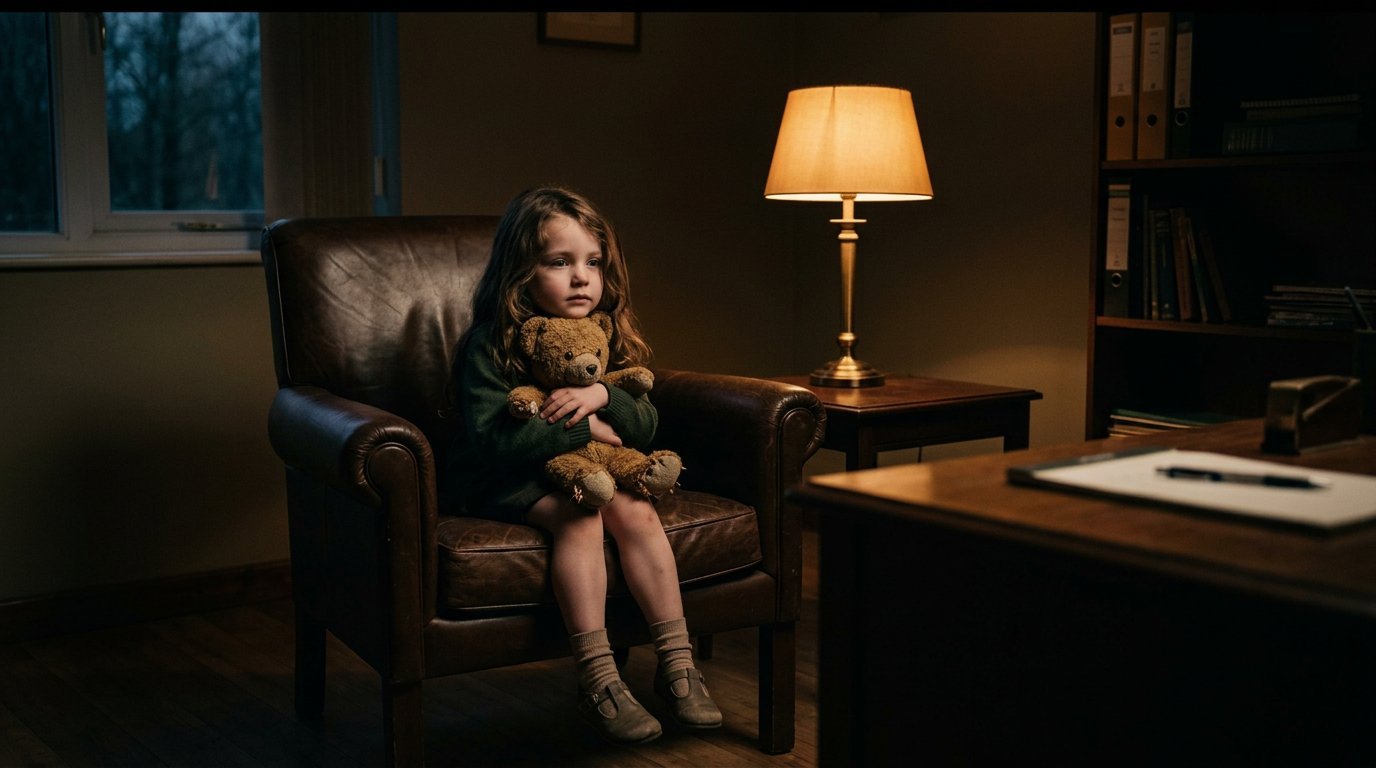
She sat in the counselor’s office hugging a teddy bear.
The counselor looked serious.
Very serious.
She explained what my daughter had said.
That her stepdad turned off the lights.
That he pressed on her ribs.
That he called it a game.
That he told her good girls didn’t cry.
I felt sick.
I couldn’t even remain standing.
I sat on the hallway floor while my mind raced through every nightmare imaginable.
I called 911.
An officer arrived quickly.
He spoke gently with my daughter while another officer took notes.
After listening carefully, he stepped into the hallway.
His expression was grave.
“Ma’am, based on what your daughter described, your husband has been engaging in behavior that needs to be investigated immediately.”
The words hit like a truck.
Within an hour, officers were at our house.
My husband was brought in for questioning.
I was terrified.
Angry.
Confused.
Heartbroken.
I kept replaying every moment of our marriage.
Every family vacation.
Every bedtime story.
Every hug.
Wondering if I had missed something.
Then investigators started asking more detailed questions.
Questions that seemed strangely specific.
Did my husband ever talk about health?
Did he worry excessively about illness?
Did he have unusual routines?
At first I didn’t understand.
Then one detective explained.
During questioning, my husband had immediately admitted to the “bone counting.”
But not for the reason anyone feared.
PART 2
The detective kept talking, laying it out in plain sentences, the way you’d tell someone the test came back and it wasn’t what you feared.
My husband had admitted everything the moment they sat him down. He hadn’t denied it. He hadn’t even hesitated. When they asked about the bedtime ritual, he described it in detail — the lights off, his hands on her ribs and sides, the counting, the quiet — the way a man describes a job he’s done for years.
That, the detective said, was the first sign this wasn’t what it looked like.
The second was the way he answered their questions. All afternoon they’d asked me strange, specific things — whether he talked about health, whether he worried about illness, whether he had routines. I’d assumed they were building a case against him. They were building a picture of his mind.
For years, my husband had lived with severe obsessive-compulsive disorder. Untreated. Undiagnosed. Hidden from everyone, including me.
And it started with a boy.
When my husband was nine, his younger brother got sick. A rare illness, the kind doctors don’t think to look for, and by the time anyone thought to test for it, there was nothing left to do. The boy died. And the brother left behind never stopped being nine years old in that hospital hallway.
He grew up certain that sickness was a thing you caught too late. That bodies hid their failures until it was too late to fix them. So he learned to check. Weight. Bruises. Growth. Anything. He checked himself for years, and then, when our daughter complained that her side hurt after soccer practice, something came loose in him and he started checking her.
Instead of taking her to a doctor — instead of telling me, his wife, the one person he should have told — he built a ritual. A game. Every night, lights off, he would feel her ribs and her sides, counting, reassuring himself she was still whole. He called it counting bones. To him it was love and terror twisted into the same shape.
To a five-year-old, it was a man in the dark touching her and telling her not to cry.
The detective said the words “no evidence of abuse,” and I should have felt relief. I felt something worse. I had married a man who had carried a dead boy inside him for years and never once let me see it. He had built a secret routine around our daughter’s body and never once said the word brother.
I didn’t know whether that made him a danger or a stranger. I didn’t know which was worse.
But the detective wasn’t finished.
PART 3
What he said next is the part I still hear at night.
No abuse, not in the way we feared. But what happened to my daughter was still wrong. A grown man had put his hands on a five-year-old in the dark and told her that good girls don’t cry. Intent or not, that leaves a mark. The case would stay open. Child welfare would be involved. There would be interviews, medical evaluations, counseling appointments, home visits. And my daughter would have to tell strangers what her daddy did at bedtime, over and over, until they were satisfied she was safe.
She was safe. Every evaluation said so. She was safe, and she was confused, and she missed her daddy.
In counseling, she tried to explain it to me once, in the flat, matter-of-fact voice of a child. She said the lights went off and Daddy made his hands flat and pressed down on her sides, one two three, like he was looking for something. She said he always stopped. She said it tickled, mostly, but she wasn’t supposed to wiggle, and she wasn’t supposed to cry, because good girls don’t cry. Then she asked me if she was a good girl.
I told her she was the best girl in the world.
Then I went into the bathroom and locked the door and cried until my ribs hurt, because my daughter had been learning, in the dark, that being good meant being quiet while a grown man touched her — and I had taught her none of it. I’d taught her please and thank you and to look both ways. I hadn’t taught her that no one, not even a parent, gets to touch her in the dark.
Our family wasn’t okay. Not yet.
The nights were the worst. I lay awake replaying every moment of our marriage the way the interviews had made me replay it. Every family vacation. Every bedtime story. Every hug. I was hunting for the monster I’d supposedly missed, and all I could find was a man who packed her lunch and read her stories and tucked her in — and who also, secretly, counted her bones in the dark.
Then one evening, after the last interview was done, he sat across from me at the kitchen table and cried.
“I thought I was protecting her,” he said.
I looked at him. Exhausted. Heartbroken. And I said, “I know.”
And I believed him. That’s the part nobody tells you about love — you can believe a man and still be furious with him. You can know he meant no harm and still feel the harm pressing on your chest.
But I knew something else, too. I said it that night with my voice low and even, because I’d already done enough screaming inside my own head.
Intent doesn’t erase impact.
Our daughter had been frightened. In her own bed, in her own home. And that mattered more than any diagnosis, more than any apology.
So I gave him my terms, quietly. He would start real, intensive therapy. He would stop hiding — from me, from her, from himself. And if he couldn’t, I would take our daughter and walk, and no amount of love would bring me back.
He agreed.
That was the easy part.
PART 4
Therapy didn’t fix him. It opened him.
The therapist started with the brother. I sat in on one of the early sessions, in a room with a box of tissues and a lamp that buzzed, and I watched my husband come apart describing a sickness I’d never heard of and a boy I’d never met.
His brother’s name isn’t mine to tell. What he described was this: a child who was tired for weeks, who bruised easily, who complained of aches, while doctor after doctor sent him home with vitamins and rest. By the time someone ordered the right test, the illness had already won. My husband was nine. He sat in a hospital hallway while adults whispered, and then he sat in a living room while adults pretended the boy had never existed.
That was the part that undid me. Not the sickness. The pretending. A whole family decided the way to survive grief was to never speak the dead boy’s name again. So my husband learned that bodies betray you quietly, and that the only safe thing is to check, and count, and never let anyone see how afraid you are.
He had been checking ever since.
The weeks that followed were the hardest of our marriage. Child welfare kept the file open, and I understood why. I was the mother who hadn’t known what happened in her own daughter’s bedroom, and they had to be sure. Every knock on the door made my stomach drop. Every question about our home felt like an accusation. I started to believe it myself — that I’d failed her, that I’d been so busy working my shift at CVS, so busy keeping our small life running, that I’d missed a man counting bones in the dark.
I imagined them taking her. I imagined standing in a courtroom and trying to explain to people in suits that I wasn’t a bad mother, just a tired one — that I worked doubles and came home and trusted the man I married. I imagined my daughter’s bed empty and the house so quiet I could hear the refrigerator hum from the driveway. I imagined all of it, every night, while the case stayed open.
He was doing the work. That’s what I told myself. He went to his sessions and came home wrung out and honest. But there were days he’d sit in the car in the driveway for an hour before he could come inside, and nights he’d sleep in the living room because our bedroom was too close to her door.
Then the caseworker called. The final home visit was set for Friday. After that, she said, they would make their determination about closing the case.
Thursday night, he didn’t come home from therapy.
I called. No answer. I called again. Nothing. I put our daughter to bed and sat at the kitchen table and waited, and the hours went by, and I thought about a nine-year-old boy in a hospital hallway, waiting for a door to open.
At 2 a.m., I heard the front door.
I stood in the dark of the hallway, and I realized I had no idea which version of my husband had just walked through it.
PART 5
He didn’t leave.
That’s what he told me at 2 a.m. in the hallway, and what he told me again Friday morning when the caseworker arrived. I don’t know what happened on the road between therapy and home that night, and I stopped needing to know. He’d gone somewhere quiet to decide whether he was the man who runs or the man who stays. He chose to stay.
The case closed. Not because anyone looked away, but because they looked long enough to see a father who was sick, not dangerous — and a family that was finally telling each other the truth.
He kept going to therapy. Every week. Intensive. For the first time in his life, he confronted the trauma he’d carried since childhood — the anxiety, the compulsions, the fear, the need to control things that couldn’t be controlled. It didn’t happen quickly. Some sessions he came home silent. Some nights I caught him standing in our daughter’s doorway, not touching her, just watching her breathe — learning to trust that she would still be there in the morning.
Months later, my daughter was drawing pictures at the kitchen table when she looked up and said, “Daddy doesn’t count bones anymore.”
My husband smiled. “Nope.”
She grinned. “What do you count now?”
He thought for a second. Then answered, “The number of bedtime stories I still owe you.”
She laughed.
And for the first time in a long while, so did we.