I never got married because I spent my life raising my brother’s twin sons. When I was 26, my brother and his wife died in a car accident, leaving behind two frightened 5-year-old boys.
Everyone promised to help, but by one they disappeared. So I became their guardian. What was supposed to be temporary turned into 13 years. I worked extra shifts, paid the bills, attended every school event, and put my own dreams on hold. Dating stopped. My social life disappeared. The boys always came first. I never regretted it.
Then their 18th birthday arrived. After the party ended and the guests went home, Mason and Noah asked me to sit down. I thought they wanted to thank me. Maybe talk about college.
Instead, they looked at each other, took a deep breath, and said something that left me completely speechless.
It was something they had been planning in secret for years.
They had been planning it for years, and the first thing I learned was that I had been wrong about the whispers. For eight months I had been sure it was drugs, or a motorcycle, or a girl with a reputation the neighbors invented. I had lain awake composing speeches I never delivered. The locked door was the spare room. The smell was toner. Mason works Saturdays at the print shop on Route 9, and for three years he has been bringing home the misprints, and I never once asked what my boys were printing.
Noah spoke first, which is itself a historical event; Noah communicates mainly in shoulder shrugs. He read from a page, because, he said, if he had to say it off the top of his head he would chicken out halfway through. Mason held the pages he wasn’t reading, the way you hold something for someone at a sink.
Aunt Maggie. Adults can be adopted. We looked it up when we were sixteen, and we have known it ever since. We are not asking you to be Mom. Mom is Mom. Dad is Dad. That does not move, and we will not let it. We are asking you to be also. You have been also for thirteen years. We want it on paper.
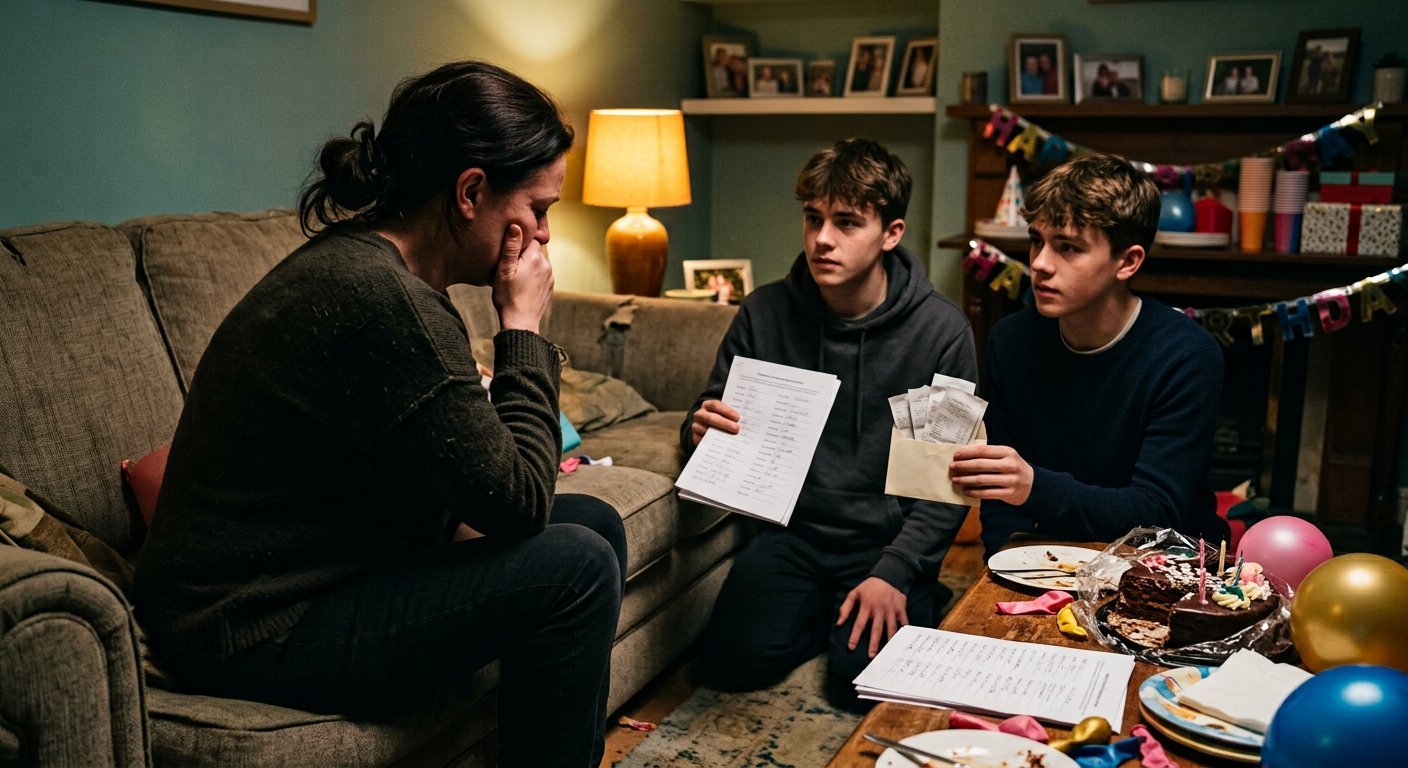
Between them on the coffee table, over the wrapped remains of their birthday cake: a petition for adult adoption, drafted, collated, and corner-stapled with the print shop’s good stapler. And a receipt.
PETITION FOR ADULT ADOPTION — DRAFT PETITIONER (TO SIGN): MARGARET A. CALLOWAY CONSENTING ADULTS: M. HAYES, N. HAYES NAME CHANGE REQUESTED: HAYES → CALLOWAY FILING + NOTARY FEES, PAID IN CASH … $412.00 (IN COINS ONCE. IT SMELLED LIKE LAUNDRY.)
“I never regretted it,” I had told everyone for thirteen years, and in that moment I learned the difference between a truth and a slogan. The regret existed. It had existed since year one. It lived in the same chest as the love, in a room of its own, and we had never once been introduced. What I meant — what I will always mean — is that I would choose it again. Choosing it again was not the same as it costing nothing.
“You found the box,” I said. I didn’t ask. The recipe box under my bed: the business plan I wrote at twenty-six in the margins of a notebook, the pressed roses, the lease I never signed, the name I had picked for a shop that never existed. They had found it in the spring, they admitted, while looking for the dryer warranty. “You gave up a store,” Mason said. “You never even told us there was a store.”
So I told them about the number. The family services office, saved in my phone for eight months of the first year. I never dialed it. I kept it the way you keep a fire extinguisher: hoping to never need it, glad it was on the wall. I had spent thirteen years making sure they never saw the price tag, and it turns out that was the one thing I should have shown them — because a price tag is also a receipt.
Mason reached into his hoodie and brought out a folded page. “We kept a list too,” he said.
THE LIST (M. & N.) EXTRA SHIFTS, FROM PHOTOGRAPHED PAY STUBS … 1,912 SCHOOL EVENTS …………………………. 214 PARENT-TEACHER CONFERENCES ……………… 41 SCIENCE-FAIR ROSES, YEARS ………………. 9 DENTIST APPOINTMENTS, DRIVEN TO …………. 58 TIMES YOU SAID “I’M FINE” AND WEREN’T ……. STOPPED COUNTING AT 100
I read it standing up. I sat down to finish it. Fifty-eight dentist appointments — I had forgotten the dentist appointments entirely, which is how you know who was keeping the real books in that house. At the bottom, in Noah’s handwriting, the same slant his father had: We know what we cost. We wanted you to know we counted.
I signed at the kitchen table with both of them watching, using the same pen I had signed thirteen years of permission slips with. It did not feel like winning. It felt like an invoice paid in both directions at once — which is the only kind of paid-in-full I have ever believed in.
That night I slept nine hours for the first time in years. In the morning there were three mugs in the drying rack, and none of us would admit to washing the other two.
The shop opened that fall, eleven months and $22,000 after the party — my own savings, my own delay, my own name over the door at last. I called it Also, because that is what we were to each other, and the sign painter charged me extra for the joke, which he insisted it wasn’t. The boys worked their first two weekends at the register and dropped the float twice, and I let them, because a business that can’t survive two dropped floats doesn’t deserve a register. Opening day, a woman came in and asked if I was the aunt from the boys’ graduation speech. I said I didn’t know I was in a speech. “You were the whole speech,” she said, and bought three bouquets she did not need.
Community college first, both of them, not the flagship with the glossy brochures, because the floats got dropped and we said so out loud at the kitchen table instead of quietly. They will transfer. The flags will wait. We have learned what flags cost.
We went to see Paul and Rachel on a cold Sunday before the hearing, all three of us in the good coats. I stood at my brother’s grave and said, out loud, in front of two men who used to be two frightened five-year-olds: “They’re mine now. Officially. You always knew.” The wind took the rest of it, which was fine. The rest wasn’t mine to say. Noah straightened the plastic flowers somebody’s guilt had left there years ago and swapped them for real ones from the shop’s seconds bucket. He did it facing away, which is how he does most of his best things.
Grief came back that winter, not smaller but better mannered, like a relative who has finally learned to call first. I mourned my brother again — this time as a co-parent who had left in the middle of a project — and I understood that the boys had been mourning the same man from the other side of the crib. We compared notes at the shop, between customers. It helped. It didn’t fix anything. It helped.
Some days I loved them and mourned my own life in the same breath, and I have never found a way to make those two not rhyme. I have stopped trying.
Rachel’s side sends a card at Christmas now, signed by the cousin who drives three hours. We send flowers back. It is not a relationship. It is a correspondence — and correspondences are how relationships begin, slowly, like everything that lasts.
The hearing was in February, in a room the size of my kitchen, before a judge with a sweater under his robe, which I took to be a good sign. No one objected. The consents were notarized; the fees were paid; the pen was the pen. The gallery held four people: my sister-in-law’s cousin, who drove three hours and whom I had met once; the sign painter, who said he came for quality control; and two empty chairs the boys had reserved anyway.
The judge asked the standard questions from the standard form, and then, because he had clearly been a judge long enough to know the form never holds the truth, he put the papers down and asked one of his own.
“What is your relationship to the petitioners?”
I looked at Mason, who shaves once a week and calls it a beard. At Noah, who still sleeps with the hall light on and would deny it under oath. At two men with my brother’s slant in their handwriting and my name about to be in their pockets.
“Thirteen years,” I said.
He wrote it down.